
📚 Books I read in April 2026
The first time that the highlight of the month is not a recommendation, a helpful book on data, and a peculiar one from a fiction author I recently discovered
Reading is callisthenics for your brain.
Reading good books is a great way to broaden your knowledge and perspectives.
Reflecting on the books I read every month helps me cement the key learnings from each one of them.
What’s better than recommending someone else a good book?
Recommending two, three, or five good books!
Here we are with the April edition of the books I read last month!
If you end up reading one of them, please let me know in the comments section.
This month’s highlight is what I'd call an anomaly1.
💫 Book Highlight: Vibe Coding by Gene Kim and Steve Yegge
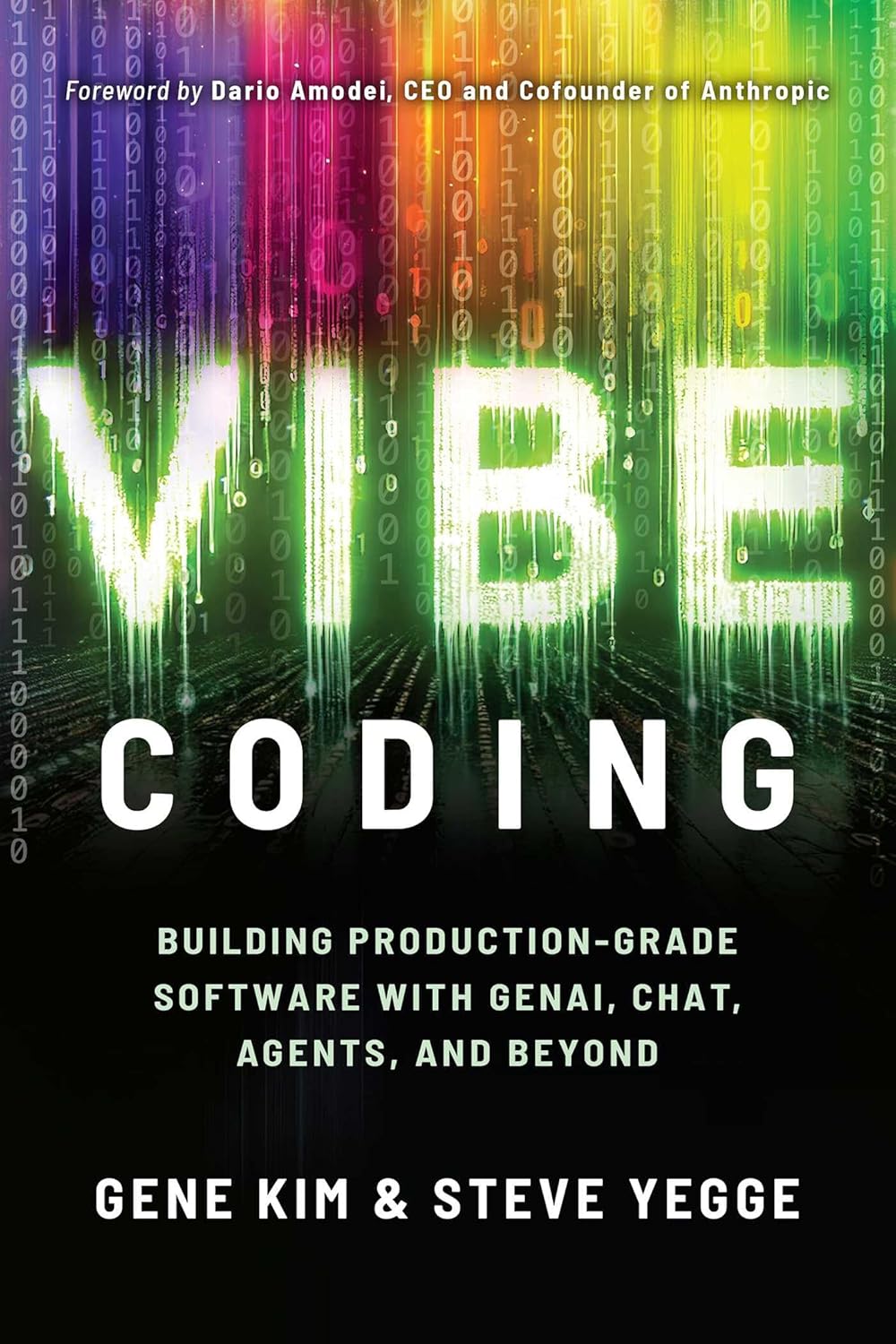
Vibe Coding, by Gene Kim and Steve Yegge
384 pages, First Published: October 21, 2025
I wanted to make Vibe Coding the highlight of the month because of how bad it is on so many levels.
The arguments are weak, the overly enthusiastic tone is borderline unsufferable, and the style is poor, unengaging—despite the author's desperate attempts at making it fun—and repetitive ad nauseam.
So, why make it a highlight at all? Because both authors are very popular, the book got a lot of coverage and attention, and I believe most people should either stay away from it or read it with their critical thinking circuits pumped up to 100%.
It is clear from the beginning that something is wrong with this book. Despite two “independent” authors writing it, Dario Amodei himself wrote the foreword. I might be biased, but I took that as a clue about what would follow, and my initial intuition proved right.
The book can be summarised with a few bullet points:
- Vibe coding is absolutely great
- If you don't vibe code, you'll be left behind
- Vibe coding is undeniably great
- We the authors and our close friends are having the time of our life vibe coding
- Vibe coding is unquestionably great
- This books is a collection of sparse ideas fed into an LLM which was supposed to write a great book, but it obviously didn't
- Vibe coding is the greatest thing ever happened to us
- AI can make mistakes, and you should not forget all the basic software engineering practices everybody seems to believe are now irrelevant
- Did we mention that vibe coding is awesome?
Not to mention that the book includes some obviously dangerous and deranged statements, such as:
It’s at least an order of magnitude improvement over my career average, and I'm doing it on the side. It's nuts. And that's why I can barely sleep lately. I have too much to do. Everything is achievable now.
I'm completely addicted to this new way of coding, and I'm having the time of my life. [Emphasis is mine]
So this is Steve, who, a few months after publishing the book, went on to write a telling blog post titled The AI Vampire, which I mentioned in detail in a previous article.
 Sergio Visinoni
While the article tries to adjust the message, the damage in the book is done: Yegge and Kim are presenting something as addictive as if that were something good and positive.
This book could have been a great opportunity for bringing in a balanced view substantiated by studies from independent researchers, but there is basically none of that.
It's all first-hand experience of anecdotes from family and friends, a very homogeneous population that sounds more like an echo chamber than anything close to a statistically representative sample.
Instead of rigor and science, we get this
Unless you still prefer to write code by hand (like a savage), you’re now officially promoted to head chef.
Coding by hand makes you a savage! WTF is wrong with you guys?
Or this
Up until now, using AI has accelerated you. But now your role is to accelerate them.
Wait a second. Are you publicly admitting that GenAI is the perfect example of what Cory Doctorow defines as a 'reverse centaur'2? And you're telling us that's a good thing?!
I would be embarrassed by even saying something like that in a late-night bar conversation.
But that's not even the most embarrassing thing. In the section titled “Substantiating the 10x Claim: Gene's Real-Life Example3”, I read this gem that almost led me to stop reading right away
To make our book the best it could be, we were copying huge chunks of the manuscript into an LLM to do things like hunt for repeated ideas, ensure that every section was novel and new, get opinions on the optimal ordering of the Part 3 practices, and create good signposting (e.g., introductions, conclusions, etc.).
While I respect the transparency of admitting the usage of LLMs to “tune” the content of the book, I wonder if the authors actually read what came out of it with their minds turned on. Because the result is a book that is unsufferably repetitive, and those good signposts are so boring and uninteresting that only an LLM might appreciate reading them. Humans will likely do as I did and gloss over them, as I tend to do the moment my brain recognises a text as being written by LLMs.
The whole reason why I read this book was that after reading some of the seminal books criticising AI, I wanted to read the best that the opposite camp could offer. Now, I genuinely hope there is something better than Vibe Coding, which was recommended to me, so I invite my readers to suggest better books making good arguments in favour of GenAI.
But you know what? I am biased.
When I sat down to write this, I asked myself the question of whether I wasn't being too hard and too damn subjective in my review. That's when a sneaky idea hit me.
Since the book is all about praising the wonders of LLMs as mostly infallible machines, I decided to do something I've never done before: I converted the book to txt, fed it into an LLM4, and asked it a few questions5.
The results were nothing short of hilarious.
Once I got past the initial sycophantic platitudes describing the book as seminal by simply echoing its content without external validation, I asked the LLM specific questions regarding citations, evidence and bias.
That's when things became a lot more interesting.
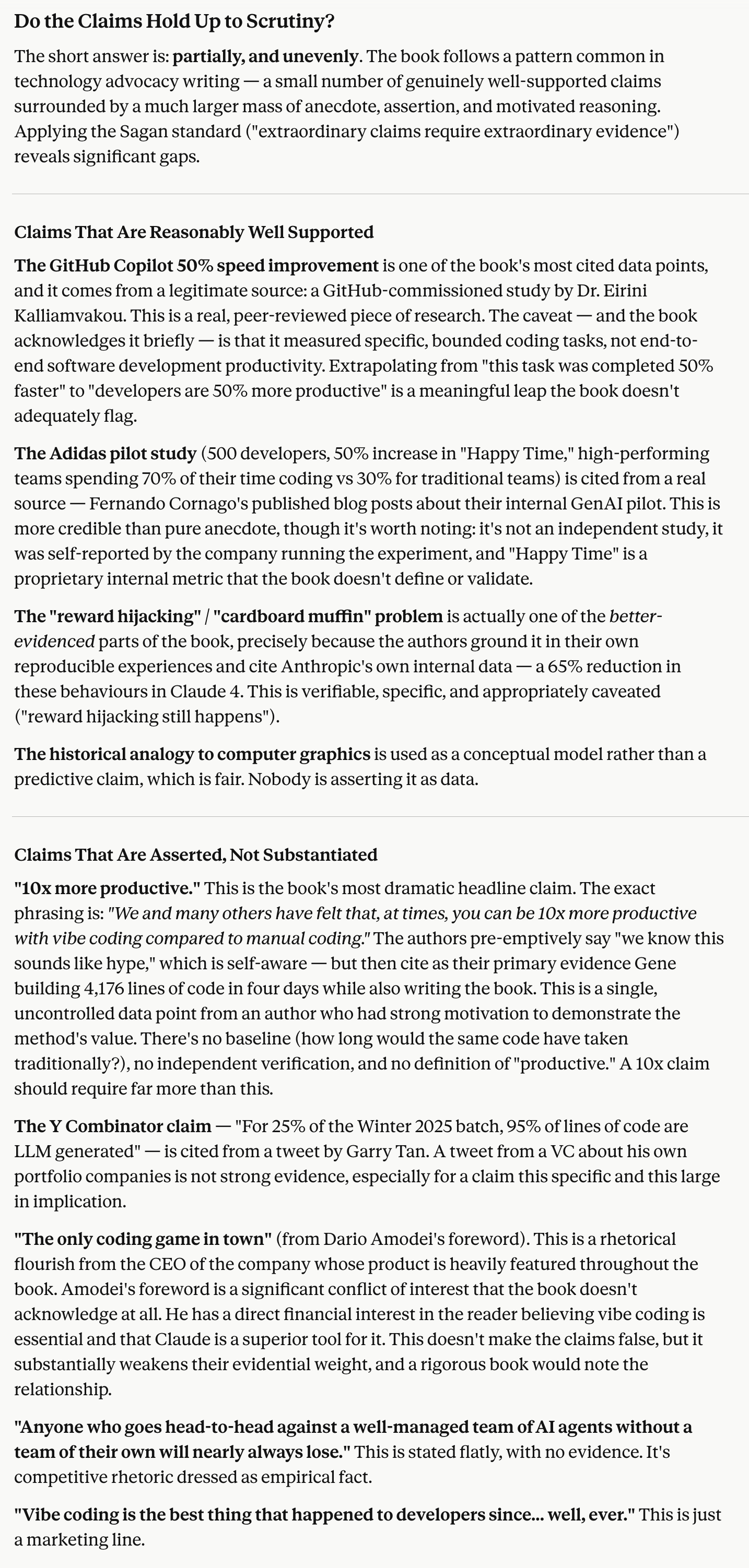
Here is what came out of the conversation about substantiating the core claims from the book:
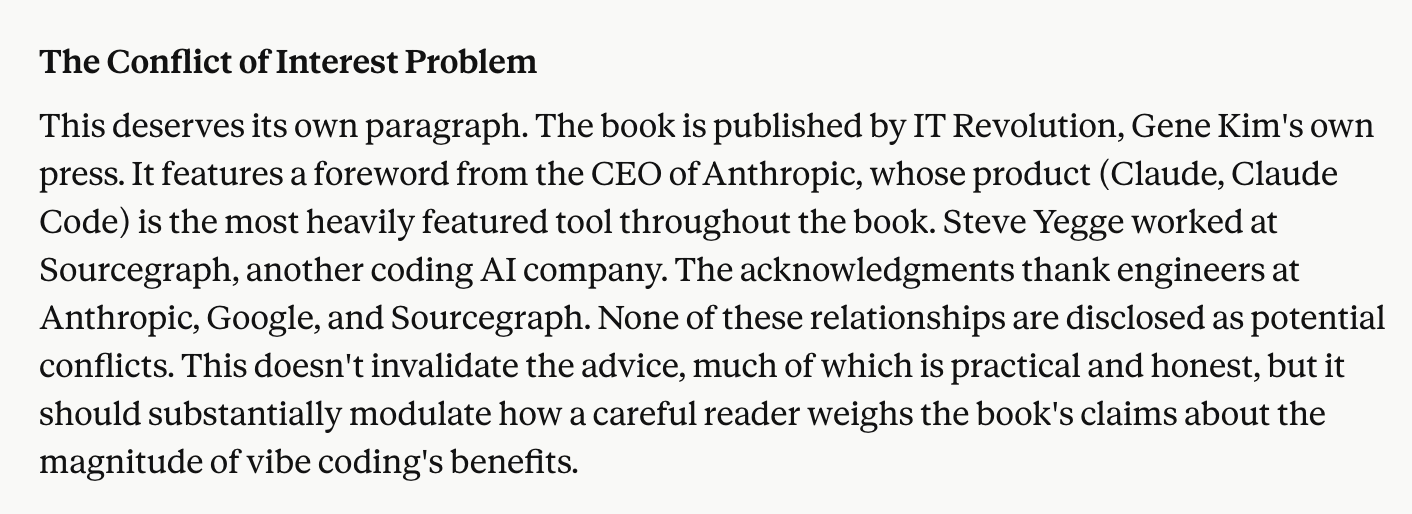
And this is what came out when looking at the balance between independence and conflict of interest with the authors
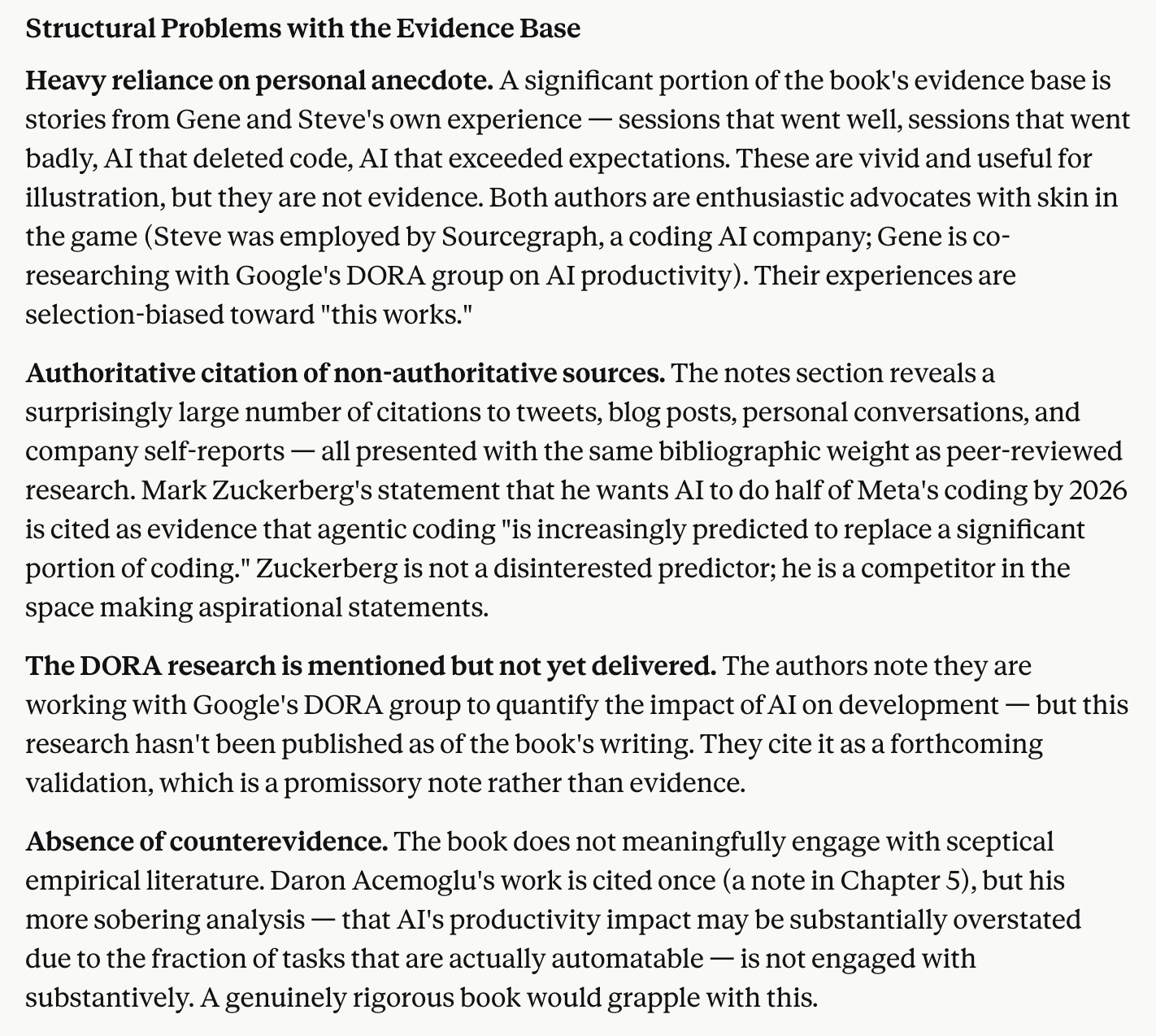
And finally, this is a summary of the problems in pure LLM style:
Now, I'm the last person on this planet who would claim that LLM-generated output is to be taken for absolute truth.
But what came out from that short exchange with Claude is either of the following:
- The LLM is wrong and just regurgitating text influenced by my questions, which undermines that fundamental belief that these tools can produce good-quality work. A belief that sits at the core of the Vibe Coding book.
- The LLM is right, which also means the book is flawed. Maybe not in its core assumptions, but clearly in the way the arguments are built and substantiated as well as the author's credibility.
I'll leave you to choose how to solve this modern time version of the Epimenides paradox6, and move on to the other books I read in April.
📚 Other Books I Read in April
Data As a Product Driver by Xavier Gumara Rigol
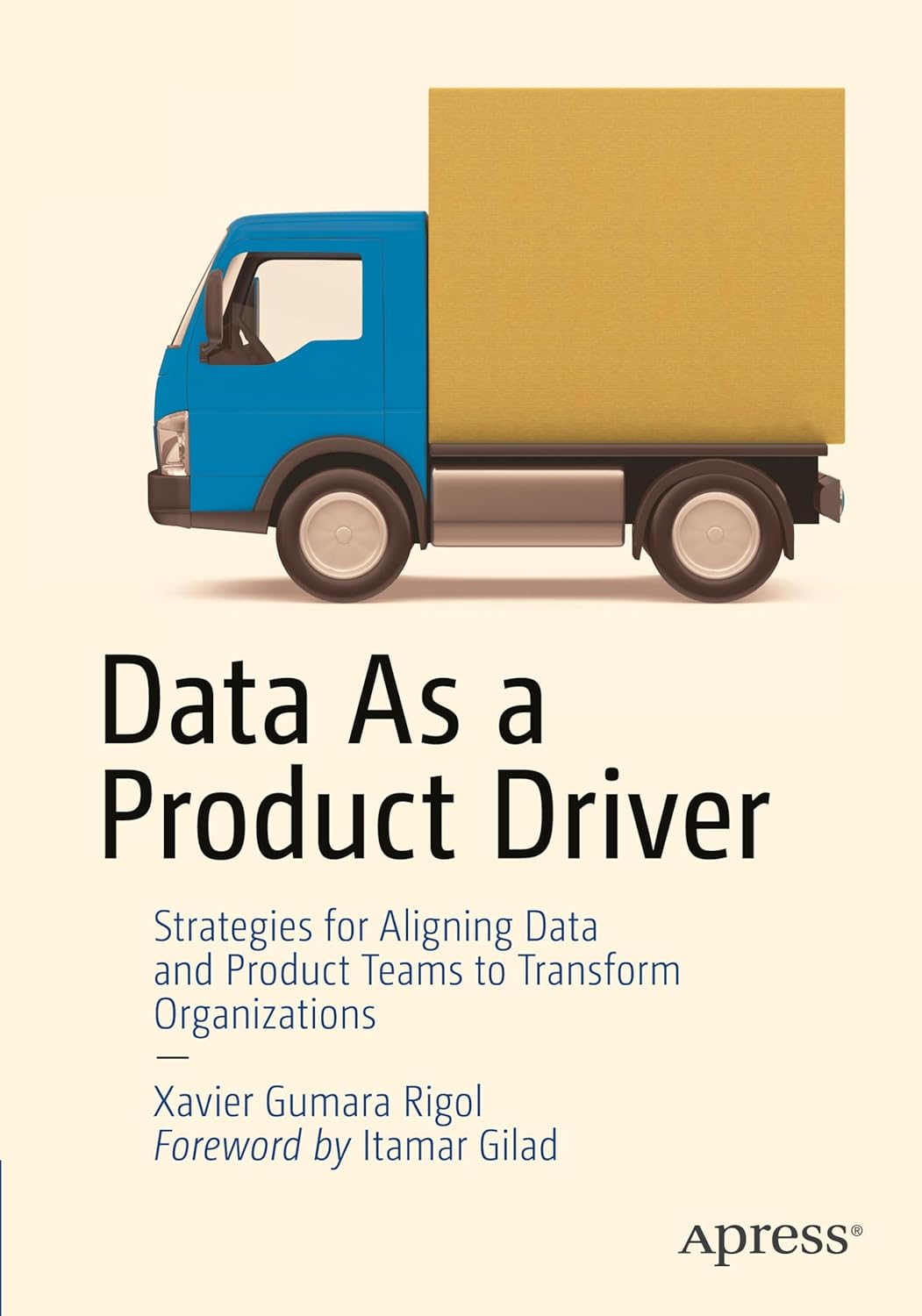
Data As a Product Driver, by Xavier Gumara Rigol
368 pages, First Published: March 17, 2026
Let’s start with the necessary disclaimer: I know the author, Xavier Gumara Rigol, as we used to be colleagues a few years ago. He sent me a digital copy of the book, asking for a review, which I of course accepted since it’s on a topic that’s very relevant for both me and the readers of Sudo Make Me a CTO.
It’s an important topic, as I’ve seen many companies struggling with making data a first-class citizen in the complex process of building digital products.
I’ve seen companies throwing money at data in the hope that it’ll magically fix things, with underwhelming results.
I’ve seen CTOs and VPs of engineering treating data as something external or secondary, not realising the importance it can and should play in modern product development.
The book does a good job of exploring both the different aspects of the data landscape and the different maturity stages. It combines concepts from product development, software engineering, data engineering, data science, and data analytics.
It’s a solid first book with a few areas for improvement. And I do have a lot of respect for the amount of time and work required to write something like this.
While I found value in most of the content, I believe the authors could have left out a couple of chapters or developed them better.
Chapter 7 on Operating Empowered Product Teams felt a bit shallow. It’s mainly a collection of “good practices” that have been around for a long time, and I felt it didn’t add anything meaningfully unique.
But my greatest dissatisfaction is Chapter 14.
Until I reached it, I was particularly impressed by how the author focused on the key foundations of data, drawing from years of experience. It felt refreshing, as it stayed away from the GenAI hype… until it didn’t.
Chapter 14 is all about that, and I found it had a different taste than the rest of the book. Almost as if the author took a leap from his own proven experience and embraced a lot of the dominating narrative. This was the only chapter that stroke me with claims such as
This change is inevitable; the tools we already use every day are becoming AI-powered, whether we like it or not.
Which I find fatalistic and not particularly deep, or statements such as
Most companies start with AI at the edge. They add GenAI-powered features to validate user demand, build internal capability, and understand the technology’s limitations. But the real competitive advantage lies in moving AI to the core. [Emphasis is mine]
Without offering substantial arguments as support.
If chapters 1 to 13 sound like a summary of decades of experiences and a lot of trial and error through different realities, chapter 14 rhymes more with the common narrative that is predominant today and mostly based on beliefs, rather than concrete results.
I couldn't help but wonder if the editors at Apress explicitly asked for something about GenAI to be included in the book, but that's just a conjecture I have no way to prove7.
But I know I’m biased on this topic, so it might be an issue with the reader rather than the writer.
That said, I do recommend anyone in a leadership position in product, tech and data to consider reading it, as it provides a helpful overview and strategies on how to increase the impact of any data organisation.
Passion simple by Annie Ernaux

Passion simple, by Annie Ernaux
67 pages, First Published: January 1, 1991
Following last month’s discovery of Annie Enrnaux, I picked up another of her books.
 Sergio Visinoni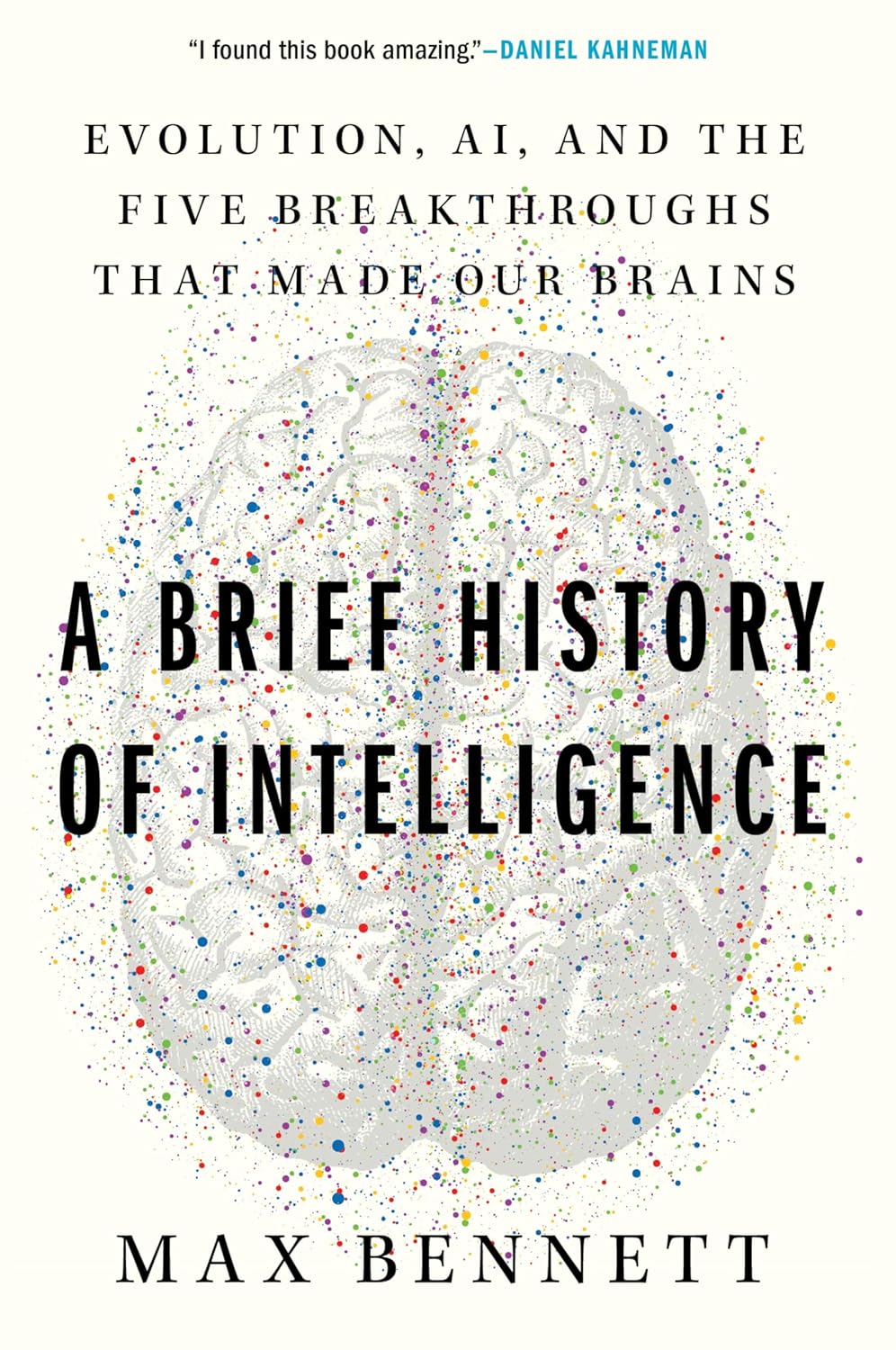
This one is surprisingly short, not even 80 pages long, and tells the story of an unbalanced relationship. It’s between a woman, the protagonist and probably the author herself, and a married man. While she’s fully engaged in it, living each moment of her day in the wait for their next encounter, he seems a lot more detached. Their relationship seems to evolve along with the book, but not really. Not much happens outside the main character's mind, and that’s the interesting part.
It’s an easy book you can read in a single session, or two at most. Clearly not as impactful as La femme gelée, but it is an interesting one to keep cultivating this unconventional author.
Share your recommendations
As I mentioned, Vibe Coding was recommended to me by a friend, Tim Frazer, and despite what might sound like an incendiary review, I do not regret reading it, as it actually helped reinforce some of my ideas around the topic.
Xavier Gumara Rigol sent me a copy of his book, which I'm grateful for.
So, if you know of an interesting book I should read, or if you're an author interested in a review, just let me know and I'll make sure to read it and share my thoughts.
See you next month with the selection of May's books!
Spoiler alert. If you end up reading the book Vibe Coding, you'll notice how they call the 2024 DORA report an “anomaly"… mainly because the results don't align with the author's beliefs. ↩
You should read the book Enshittification I recommended a couple of months back. Alternatively, check out this blog post from Doctorow to get an idea of what a reverse centaur is. I always think about Modern Times as the industrial equivalent, but that's because my mental library is full of pictures from movies. ↩
I told you, it's all about anecdotes and biased personal experience that supposed to be evidence for bold claims such as 10x productivity improvements. ↩
Given that Vibe Coding seems to have a penchant for Anthropic, I decided to use Claude Sonnet 4.6. That’s not an endorsement. I just picked the one that in my mind should have been the closest to the author's mindset to counterbalance my own biases. ↩
I might have mildly violated the current copyright rules by doing so. But as the authors didn't even mention the fundamental copyright issue at the core of training datasets, I assumed they'd excuse me, especially when all I did was feeding the LLM overlord with their book, which is likely by now already in their training dataset anyway. ↩
If you're not familiar with it, WikiPedia is a better option than burning tokens. ↩
Well, in fact, this is something I want to figure out once the review is published. Given that I know the author, I'll take the opportunity to get more context around the reasons for including chapter 14 in the book. ↩
Comments ()