

📚 Books I read in February 2025
A perfect balance of fiction and non-fiction books, all of them highly relevant to today's world.

Welcome to the February issue of the monthly segment in which I review the books I read last month.
Last month I went through a total of 4 books, all very relevant to the current technological and geopolitical landscape.
Les Guerriers de l'Hiver by Olivier Norek

Les Guerriers de l’Hiver by Olivier Norek
431 pages, First Published: August 29, 2024
Les guerriers de l'hiver is another historical novel that focuses on key events of the XX century. After the series of books by Scurati on Mussolini, I decided to pick up this book from a French author I didn't know yet. It tells the story of the Winter War1 between the Soviet Union and Finland between November 1939 and March 1940. It's one of the many fronts opened during WWII, often forgotten in the main recounts of the last world conflict.
The book tells the story of how a small army of brave and motivated soldiers in the Finnish army managed to resist and inflict massive losses to one of the greatest armies of that time, at least in sheer numbers. Its main character, Simo Häyhä, is a war hero who perfectly embodies the whole country's image. He is a deadly sniper, unparalleled in the Finnish army for his ability to shoot targets at a distance. Around him a whole legend arises, and the Russian soldiers start calling him the white death, Belaya Smert, for his ability to hide in the snow and bring death into the enemy camp without being seen or heard. He's so effective that simply evoking his name is enough to terrorise enemies and push them to retreat in fear.
Yet, he's one of the humblest persons on earth.
He is driven by the responsibility of protecting his country from the invader first, and then by the need to find vengeance once one of his best friends is killed on the field. Simo is one of the best examples of the famous Finnish Sisu.
Sisu is a Finnish word variously translated as stoic determination, tenacity of purpose, grit, bravery, resilience, and hardiness. It is held by Finns to express their national character. It is generally considered not to have a single-word literal equivalent in English (tenacity, grit, resilience, and hardiness are much the same things, but do not necessarily imply stoicism or bravery).2
If Simo is the main hero, the whole army and country play a significant role in Norek's book. They demonstrated that motivation and determination can lead a young small country to resist the invasion of an attacker, an order of magnitude bigger in terms of army, weapons, and population.
Despite the war ending with the Soviet Union officially winning and taking about 9% of the Finnish territory as a reward, the Soviet side suffered massive losses. The embarrassment was so great that memories of the winter war were long silenced under Stalin. The Soviets expected to win the easy Finnish war in a matter of a few weeks, but after a long and deadly winter, they managed to conquer just a fraction of the territory.
It's ironic and tragic that something similar is happening again a century later. Unfortunately, the conflict in Ukraine has been going on for more than three years now. It's again a case of an arrogant invader who believes they can win the war in weeks due to their military superiority.
Let's see how this one ends, but reading Norek's book is a great way to remind ourselves of our human tendency to repeat the same mistakes from the past.
Similarly to Scurati's books, one thing that makes Les guerriers de l'hiver a remarkable achievement, is its nature of a deeply documented historical novel. All dialogues and events come from archive material or direct testimony from witnesses or historians.
I admire the meticulous work that goes into creating such a book.
Such a dedication is more akin to greatness than any fancy entrepreneurial achievement boasted on social media.
A World Without Email by Carl Newport

A World Without Email by Cal Newport
320 pages, First Published: January 1, 2021
I have read all the non-student books by Cal Newport, but for some reason A World Without Email had managed to elude me. This is the second to last book, published before Slow Productivity, which I read and covered about a year ago.3 I guess the clickbaity title had put me off for a while, but I decided I had to look at what was inside, and I wasn't disappointed.
The book follows Newport's now-common structure. The first part, aptly titled The Case Against Email, argues the case for the problem.
The second part offers practical advice on facing the challenge and overcoming the pitfalls of knowledge work's dominant communication and collaboration practices.
Newport starts the book by defining the core of the problem, something he calls The Hyperactive Hive Mind.
A workflow centered around ongoing conversation fueled by unstructured and unscheduled messages delivered through digital communication tools like email and instant messenger services.
Such workflows have emerged organically in the workplace. No one has ever sat down and decided this is how we should organize work.
Why did that happen then?
Newport argues that there are a couple of major drivers that led to the hyperactive hive mind:
Technological determinism. Technological innovation often alters our behaviours in ways neither intended nor predicted by those first adopting the tool. When people invented email, they were not predicting a future where people check their inboxes every 7 minutes on average.
Tragedy of the commons. In this specific case, it's a tragedy of the attention commons. For every individual participating in the system, unscheduled messages represent the most convenient way to deal with an issue or a need. It's the path of least resistance. The overall effects on the system, though, are nefarious.
In the book's second part, Newport offers many principles and practices for designing deliberate workflows to save you from succumbing to the hyperactive hive mind approach. I won't mention all of them; instead, I will focus on some essential points.
I'll start with the Attention Capital Principle:
The Attention Capital Principle
The productivity of the knowledge sector can be significantly increased if we identify workflows that better optimize the human brain's ability to sustainably add value to information.
One could argue that it should be every manager's job on this planet to do just that: designing workflows that maximise the ROI of attention capital. Yet we are often the main culprits of that not happening.
An explanation for that can be found in another principle that Newport introduces a bit later in the book, the Protocol Principle:
The Protocol Principle
Designing rules that optimize when and how coordination occurs in the workplace is a pain in the short term but can result in significantly more productive operation in the long term.
Too many managers make the mistake of focusing on their convenience rather than experiencing the short-term pain required to establish effective protocols.
Some do that deliberately, while others genuinely believe that what feels inefficient at the individual level is also inefficient at the organizational level. They live in a world of local maxima and dismiss any form of structured processes as unnecessary bureaucracy.
Of course, there is such a thing as unnecessary bureaucracy, but between the hive mind and that other extreme lies a broad range of possibilities for structuring our organization's work more effectively.
That's why I recommend anyone in charge of a team, or even people with a high degree of autonomy over their own time, read A World Without Email and start implementing some of its key advice.
Marine Le Pen Présidente by Guillaume Hannezo, Hakim el Karoui, Thierry Pech

Marine Le Pen Présidente by Guillaume Hannezo, Hakim El Karoui, Thierry Pech
261 pages, First Published: January 16, 2025
Call me old-fashioned, but I love listening to the radio when doing chores or driving around. I especially enjoy radios that offer in-depth political, societal, and cultural analysis.
For the youngest readers: it's a bit like podcasts, except you don't have to spend 30 minutes deciding which episode to listen to for the next 15 minutes.
One of my favorite radio stations is France Inter, where I first heard about Marine Le Pen Présidente, Dystopie Politique 2026 - 2029.
It's a dystopian fiction novel in which Marine Le Pen succeeds in being elected president of the French Republic.
This scenario is becoming more likely given the popularity of far-right movements and parties in the past decade, not only in the US, where Fascist Inc. is running one of the most influential countries in the world, but also dramatically so across Europe.
The novel is well written, though it's clear it's written by essayists used to writing fiction books. It's not the highest examples of literature we've seen coming out of France, but I'm pretty sure that was never the authors' intent.
Instead, they leverage their extensive experience in political and economic affairs to draw a portrait of what the first half of a presidency led by a populist leader could look like. Focus on security and immigration, reform of the main institutions of the republic to weaken them in favour of an authoritarian presidentialism, and an irresponsible budget handling to finance populist measures aimed at keeping the voters happy.
All that on the backdrop of an anti-European discourse and an increased isolationism of the nation.
Is this exactly what would happen if Marine Le Pen were elected in the next presidential elections? We don't know.
The authors have their own biases and preferences and are not shy about them.
None of them is even remotely close to the positions put forward by the RN party (Rassemblement Nationale). At the same time, their work is well documented and grounded in facts, declarations, and political programs up to October 2024.
What they describe is clearly a possible scenario.
That possibility should encourage voters to think twice before accepting the promises of a leader whose main narrative is based on fear and disgust.
An interesting detail is that the book has been written before Trump's election in the USA, and the rise of Elon Goebbels as a digital version of the Reich Minister of Propaganda. They failed to get the AfD to run Germany, but they might achieve in propelling Marine Le Pen to what would be a disastrous victory in France. Unless by then we've all come to realize that threatening tariffs, carrying chainsaws, or speculating on war zones are not the most effective ways to promote the values of democracy in the world.
I don't know if they plan to make an English translation of the Marine Le Pen Présidente, but I recommend that all French-speaking readers, especially those who will vote at the next presidential elections, read it.
The Intelligence Illusion, Second Edition, by Baldur Bjarnason
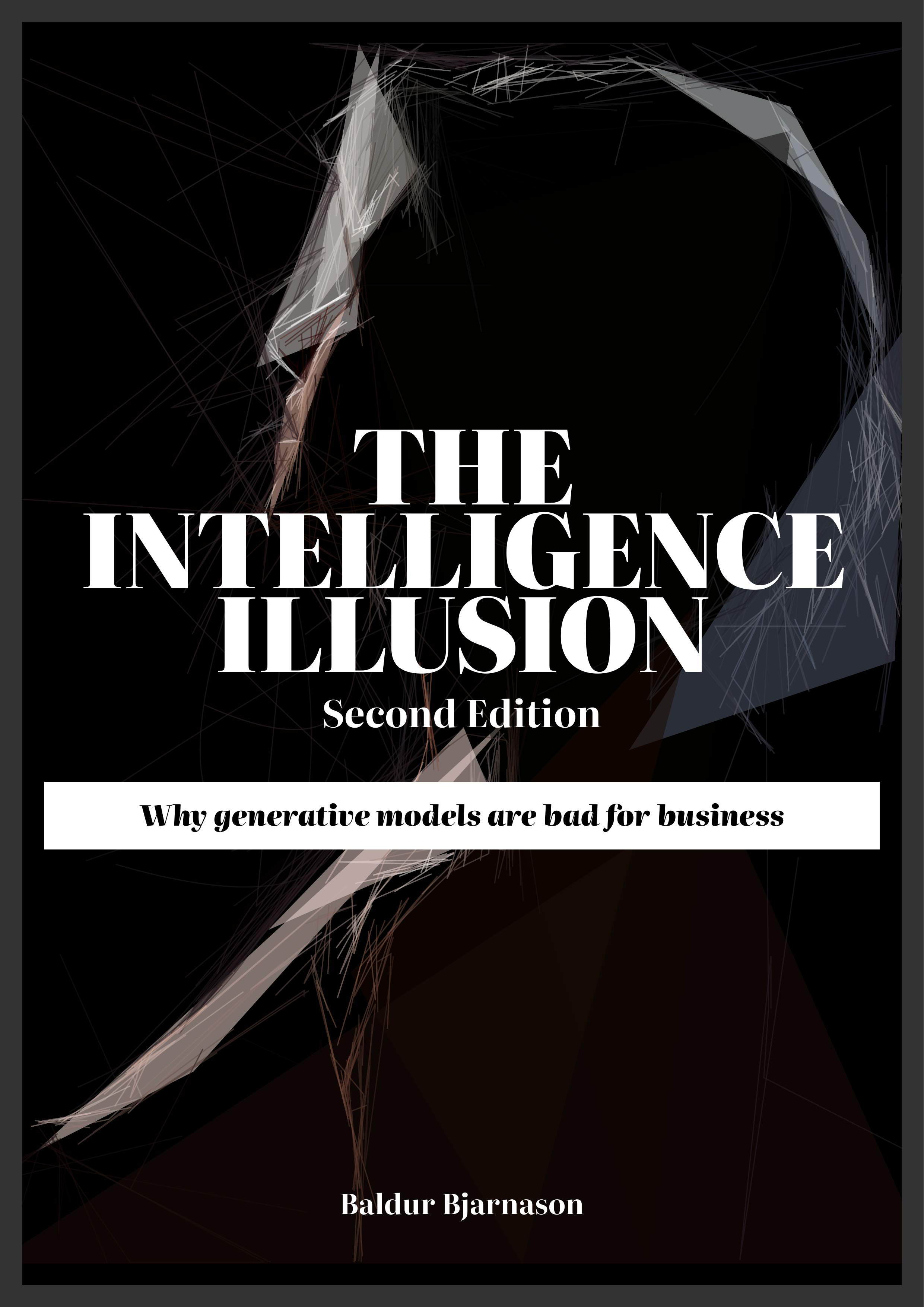
The Intelligence Illusion, Second Edition, by Baldur Bjarnason
290 pages, First Published: November 27, 2024
When I read the first edition of The Intelligence Illusion, I closed it by hoping there would be an updated second edition soon4. I was delighted when I saw it announced a few months ago, and quickly found a way to add it to my reading schedule.
The book covers the same topics as the first edition, adding and referencing papers or articles issued since.
I particularly enjoyed the chapter on the LLMentalist effect, which compares the mechanisms used by psychic con artists to the ones we often see in LLM-based chatbots. Remarkably, the fact that the smartest people tend to be the easiest to be fooled by psychics:
What's more, susceptibility has nothing to do with intelligence. Somebody raised to believe they have high IQ is more likely to fall for this than somebody raised to think less of their own intellectual capabilities. Subjective validation is a quirk of the human mind. We all fall for it. But if you think you are unlikely to be fooled, you will be tempted instead to apply your intelligence to "figure out" how it happened. This means you can end up using considerable creativity and intelligence to help the psychic to fool you. Because you think you can't be fooled, you also bring your intelligence to bear to defend the psychic's claim of their powers.
What's more interesting though is the overall outlook Bjarnason shares on the tech industry with this second edition.
If, at the end of the first one, he expressed some hope that the industry will address the main risks and pitfalls of GenAI soon, he seems to have lost all hope by the time he finished this new revision in November 2024.
I recently shared some of my reflections backed by research on the risks of overreliance on GenAI5, specifically how they could harm our cognitive abilities. I will keep following that branch of studies until their funds are cut for efficiency.
Bjarnason's voice is one of the voices I recommend anyone in this industry follow closely. He can help us see things from a different angle than the dominant narrative.
If you didn't take my recommendation to buy and read the first edition, you're still in time to go and read the updated version.
If you enjoyed this
This newsletter is free, and I intend to keep it free forever.
Sharing it with others helps immensely in growing it.
Engaging with my professional services is a great way to ensure I can continue dedicating many hours each week to producing what I hope to be high-quality content.
Those services articulate around three legs:
Fractional CTO or Advisory roles for B2B companies. Find out more on this page.
Individual Mentoring and Coaching for Engineering Leaders. Find out more on this page.
A paid membership/community for engineering leaders. Find out more on this page.
If your needs fall into a different category, such as newsletter collaborations or sponsoring, please reply to this email or schedule a free call via this link.
See https://en.wikipedia.org/wiki/Winter_War for more details on the Winter War.
Source Wikipedia: https://en.wikipedia.org/wiki/Sisu
Here you can find the article in which I covered Slow Productivity.
See this article from last year for a review on the first edition.
In case you missed it, here is the mentioned article
