

📚 Books I read in October 2025
A great book at the intersection of Strategy, Architecture and Organizational design, and two fiction books from a couple of my favorite authors

Reading is calisthenics for your brain.
Reading good books is a great way to broaden your knowledge and perspectives.
Reflecting on the books I read every month helps me cement the key learnings from each one of them.
What better than recommending someone else a good book?
Recommending two, three, or five good books!
Here we are with the October edition of the books I read last month!
If you end up reading one of them, please let me know in the comments section.
💫 Book Highlight: Architecture for Flow by Susanne Kaiser

Architecture for Flow, by Susanne Kaiser
400 pages, First Published: December 7, 2023
I discovered this book’s existence through last month’s read, Learning Domain-Driven Design, as it was mentioned and quoted a few times.

What really caught my attention about it was that it combined 3 disciplines that are often — too often — only looked at in isolation: Wardley Mapping, Domain-Driven Design, and Team Topologies.
While I’m a complete novice on the Wardley Mapping side, and have been considering getting to know the tool better for quite some time, I’ve often been thinking at the intersection, or should I say the combination, between the architectural principles of DDD and the socio-technical practices distilled through Team Topologies.
When I discovered that Susanne Kaiser had written a book about how to apply these different disciplines in conjunction, I immediately looked for and found the book in the O’Reilly media catalogue and started reading it.
Overall, I must say Kaiser has nailed it.
The book follows a fairly common structure with the first part devoted to introducing the theory of the different disciplines, followed by a section focused on understanding interactions and synergies across them. Finally, the book closes on the third part, which illustrates a concrete example of team and platform modernization through the application of the concepts introduced in the previous two sections.
What made it stand out for me were two key traits.
The first one is that the author is clearly knowledgeable in the domain of architecture, strategy, and organizational design, but regularly resists the temptation to verbosity or side quests. The book is not intended to be a full reference manual on any one of the three presented disciplines, but rather a good first pragmatic approach on how to deploy them in real case scenarios.
Secondly, chapters are full of visually engaging diagrams and illustrations with a very peculiar and recognisable style, which makes the digestion of the somewhat abstract concepts a lot easier.
The following example can give you a clear idea
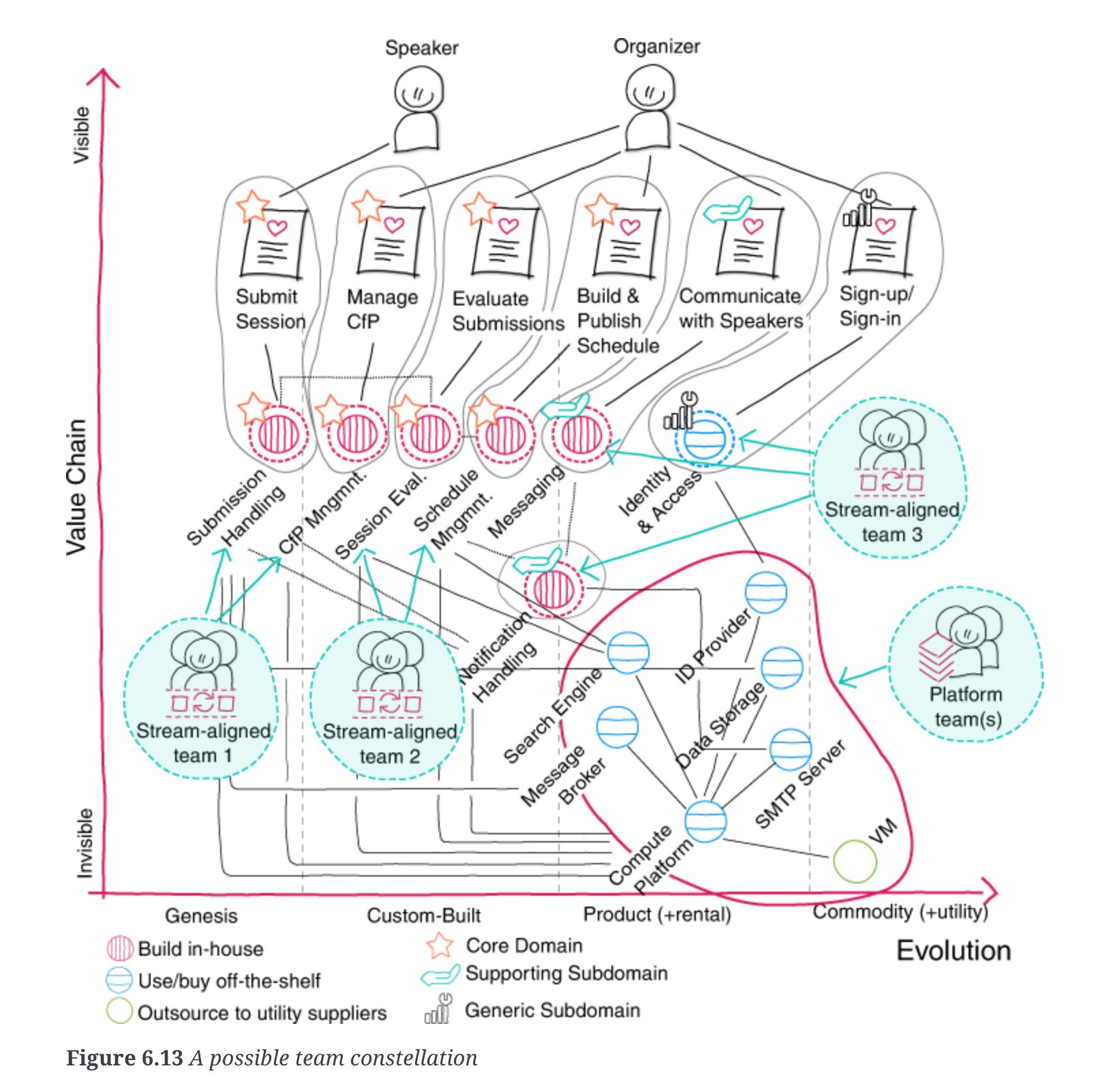
In a single picture, Kaiser was able to bring in elements from the business strategy via a Wardley map, overlayed with information about subdomains and their classification (from DDD), and then mapping those domains to teams owning them. The information density is increasingly high, yet it retains a degree of clarity that I’d rarely see when trying to combine such an amount of information from different contexts in a single picture.
This level of visual clarity is one of the main takeaways for me in this book, on top of all the valuable theoretical and practical insights.
There is one ask I’d like to address to the author for a future second edition, which doesn’t diminish my appreciation for the book. It concerns Part III, in which Kaiser describes the full process of taking a system through the journey of optimizing for flow.
The author made the choice of starting with a legacy system with all the common pitfalls we’re very used to seeing:
Teams organized in functional siloes (Frontend, Backend, Infra)
Big Ball of Mud monolithic architecture
Lack of architectural depth both in terms of discourse and implementation
That’s a scenario I’m very familiar with, and I guess most other people are.
It’s also a scenario that is so commonly used in similar books that the way the “solution” unfolds feels a bit too obvious. I wouldn’t be able to list all the books or articles that describe that canonical bad scenario, but there are plenty.
What I’ve seen far less, and what I’d love to see in a future edition, is the author pick concrete examples that are less obviously wrong, yet have a significant margin for improvement. Some examples that feel more in tune with the tech landscape in 2025 could include:
A team that has migrated to micro-services and stream-aligned teams, but made some suboptimal choices in terms of domain boundaries and the corresponding bounded-context implementations
Platform teams that are struggling to deliver value due to a combination of an unclear mission, a lack of focus, and an underinvestment in customer centricity
A company that needs to refocus its business by stopping certain initiatives, reducing the workforce by a significant percentage, and needs to deal with the complexity built over time by a much bigger organization
The list could go on, but you get the point. In essence, fewer textbook examples and more concrete examples that go beyond the basics and touch the more advanced, or rather, more relatable family of problems.
That said, I think the book is a great read in its current form, as it fills a clear void. Highly recommended to engineering leaders, senior engineers, and architects, as it’s full of helpful insights on how to reason about architectural and organizational evolution.
Among other things, it triggered my curiosity and interest in Wardley Mapping, a subject I want to learn more about.
If anyone out there has a good recommendation for a book focused solely on this topic, please share it in the comments section.
📚 Other Books I Read in October
Time for a small confession: I cheated a bit on the previous book. To be completely honest, I finished reading it on November 1st. So, technically, it was supposed to be covered in the November list, but I gave myself a free card to include it in the October issue anyway. I hope this won’t cause too many people to unsubscribe.
Two other books made up my reading list for the month, they’re both fiction books and they’re both from French authors.
La Horde du Contrevent by Alain Damasio

La Horde du Contrevent, by Alain Damasio
746 pages, First Published: October 1, 2004
I find it hard to capture the full nature of this outstanding book. Let me start by saying that it’s definitely in the list of my favorite books for this year, and has a place in the list of all the fiction books that I found the most impactful, surprising, and worthy of my full admiration for the author.
La Horde du Contrevent is Damasio’s most famous book, the one that brought him to the attention of a broad audience, yet for some strange reason, I had first met this author through two other works: La vallée du silicium, a collection of essays on the most extreme aspects of the ongoing antropological experiment commonly referred to as the Silicon Valley, and Les Furtifs, a sci-fi book that shared a few themes I also found in La Horde.
What makes this book so special? A few things.
First of all, similarly to Les Furtifs, it’s a book that takes some time to get used to. The narration alternates through the first-person voices of the different members of this weird elite group called “La Horde”. Each one of them has a personalised graphic symbol, a gliph, that identifies them through different chapters. The world in which they operate has something familiar, but is also very odd and unique. It takes some time to get a sense of what is going on, who the main characters are, what their story is, and what the hell they’re supposed to do. But once you pass the peak of estrangement, you get hooked on the story until the last page.
Secondly, the author is capable of writing in significantly different styles and registers for different characters. Collectively, they cover such a broad range that you start wondering how a single person could express themselves in so many different ways. There is an insane level of technique and knowledge involved in such a style of writing.
Finally, the story, which I’m not going to spoil, is full of surprises and rich in development. The different characters go through a long internal journey as the story progresses, and you’re literally walking alongside them.
I absolutely loved how it ended. It gave me the temptation to go back and re-read it immediately to catch potential hints of it through the story. Which I didn’t, of course, but I plan to do sometimes in the future.
After reading La Horde du Contrevent, I’ve definitely added Damasio to the list of my favorite authors.
Surface by Olivier Norek

Surface, by Olivier Norek
425 pages, First Published: January 1, 2019
The attentive reader might recognise the name here, well done. As a matter of fact, I’ve been reading quite a lot of books by Norek in the last year, and as I’m writing these words, I’m going through the last of his books I haven’t read yet. I’m starting to miss him already, but I’m confident something new will come out soon.
In the meantime, I got the pleasure of reading Surface, an engaging story of a broken police officer who is given the chance to leave Paris and spend some easy months in a quiet rural village.
What was supposed to be little more than a paid vacation turns out to be the beginning of a breathtaking investigation into some dark events from the past history of the village.
Not my favorite Norek, but I found it an engaging story that took me just 3 days to read.
If you want to get to know this author, I still recommend starting from the Trilogie 93 series of books on Captain Costa and his team. If you want to know more about it, I covered it in a previous issue.

Help keep this newsletter free
I love writing this newsletter, and I intend to keep it free forever.
If you want to support my work, you can engage with me in one of the following ways:
If you need help with your Startup, Company, or team, I can support through advisory or fractional services. Find out more on this page.
If you need personal support to overcome challenges and grow as an engineering leader, I can support you through Mentoring and Coaching. Find out more on this page.
If you are looking for continued support and the chance of joining a thriving community of like-minded people, I host a Community for engineering leaders. Find out more on this page.
If your needs fall into a different category, such as newsletter collaborations or sponsoring, please reply to this email or schedule a free call via this link.