

📚 Books I read in September 2025
A great discovery in the Business and Architecture intersection, and binge-reading a saga I fell in love with

Reading is calisthenics for your brain.
Reading good books is a great way to broaden your knowledge and perspectives.
Reflecting on the books I read every month helps me cement the key learnings from each one of them.
What better than recommending someone else a good book?
Recommending two, three, or five good books!
Here we are with the September edition of the books I read last month!
If you end up reading one of them, please let me know in the comments section.
💫 Book Highlight: Learning Domain-Driven Design by Vlad Khononov

Learning Domain-Driven Design, by Vlad Khononov
340 pages, First Published: November 16, 2021
I had my first exposure to DDD around 2014/2015, when I got the chance to attend a training led by none other than Eric Evans himself! It happened on the initiative of a very senior architect that I barely knew at the time, who ended up becoming a good friend.
But besides cementing relationships, that experience forever changed the way I thought about the intersection of business and architectural decisions. I went on applying DDD principles and approaches on multiple occasions. I own a copy of “The Blue Book”, Eric Evans’ seminal Domain-Driven Design book from 2003, but I must confess something I’m a little embarrassed about: I never read it in full.
As I was on my way back from the two months on the road with the family, I did what I often do. I checked out the list of book bundles for sale on Humble Bundles, one of the sources where I get my daily fixes of good reads. I was positively surprised to discover they had a Software Architecture 2025 bundle, offering a bunch of interesting recent titles from O’Reilly on the topic.
The bundle immediately caught my attention as it included titles covering DDD, System Thinking, and Data Mesh, among other subjects. It was an almost instant purchase.
In case you’re not familiar with Humble Bundles, I highly recommend them. They regularly offer attractive book bundles (or even game bundles, if that’s your thing) for ridiculously accessible prices. Cherry on top, a portion of the sales goes directly to charities.
If you get hooked, you can always thank me later!
Back to the topic of this month’s highlight. One of the books in the bundle, and the first one I started reading, is Learning Domain-Driven Design by Vlad Khononov.
The reason why I started there is twofold.
On the one hand, I wanted to put an end to my embarrassment with regard to the mainstream DDD literature by picking up this book that promised to be more accessible and easier to read than the original DDD book.
On the other hand, in September, I have been involved with a few client works involving the always tricky and exciting subject of aligning technology with business when the business is undergoing some major refocusing of its strategy. As it had been some time since my latest involvement with such discussions, I wanted to refresh my knowledge of DDD and rediscover some of its aspects, some 10 years after my first encounter with it.
I’ve already covered this second point in my latest article, where I cover what I believe are the core benefits of the DDD approach from a strategic perspective, but that’s only part of what I found in Khononov’s book.

Learning Domain-Driven Design is the book I’d recommend to anyone who wants to get started with DDD in 2025. It does a great job at covering the fundamental pieces of the discipline while keeping the whole topic very accessible.
The first part of the book covers the Strategic Design aspects of DDD, the part that I believe most CTOs will find beneficial. In this first part, Khononov guides the reader on the fundamentals of Domains and Subdomains, their classification, Bounded Contexts, the fundamental cross-domain integration patterns, and helpful heuristics on how to choose different approaches.
In the second part, the book moves into the Tactical Design part of DDD, exploring different patterns in increasing order of complexity. Again, the author offers very helpful heuristics and decision trees to help guide the reader in selecting the implementation approach that is the best fit for the context it serves.
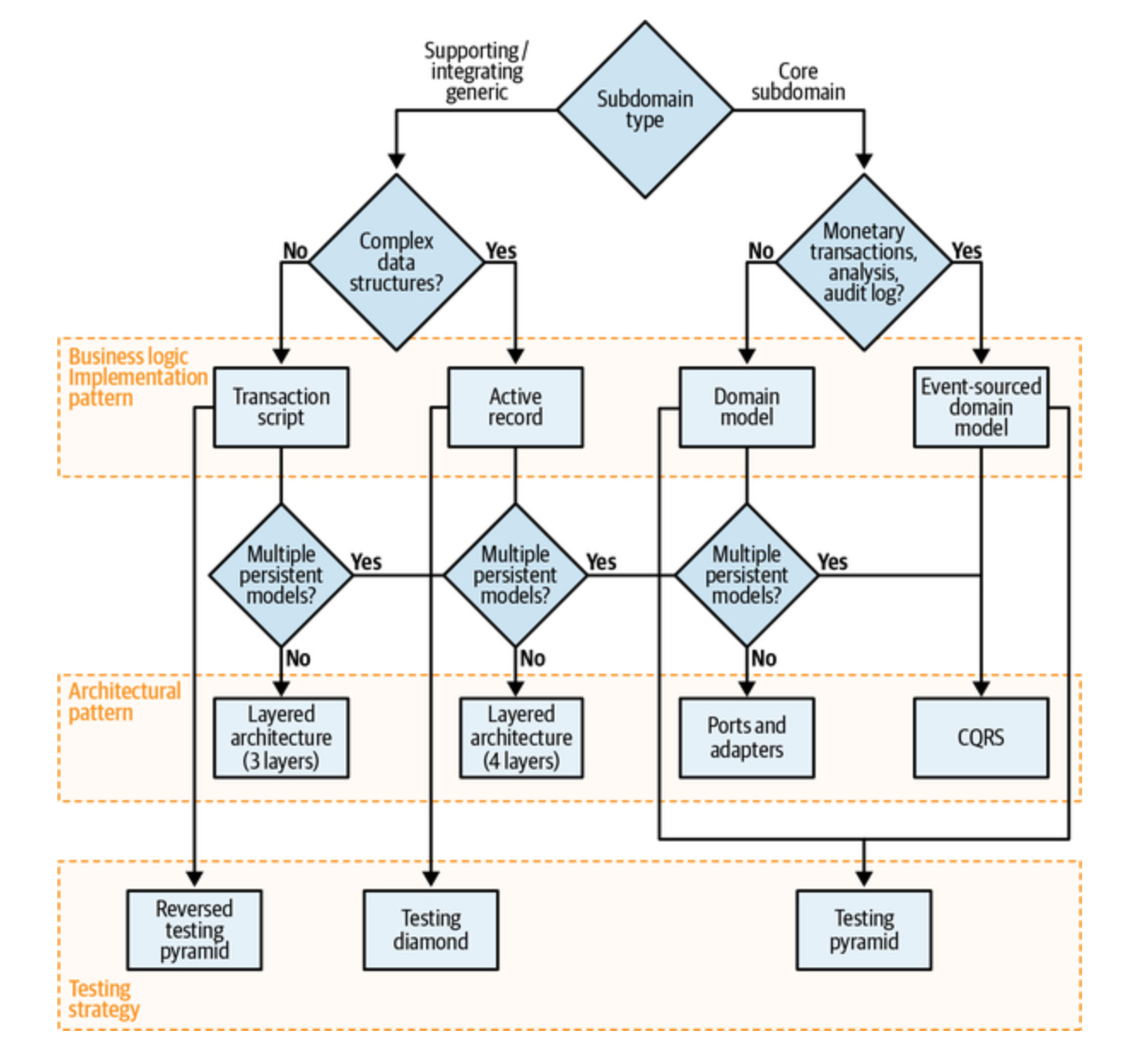
Part three is all about applying DDD in practice, providing powerful insights on how to design systems using DDD, from architectural decisions to testing strategies. It covers aspects that are very common in practice but not so commonly found in literature, such as the evolution of subdomains over time. In this part, you will also find an entire chapter devoted to the concept of Event Storming, a practice that didn’t exist when the DDD book came out in 2003, but has now become common practice to help teams identify subdomains, their classification, and the corresponding bounded contexts.
Finally, part four offers an interesting analysis of how DDD relates to common modern trends in distributed systems architectures: microservices, event-driven architectures, and data mesh. I particularly enjoyed these chapters as they provided powerful insights and mental models to help connect the dots between the sometimes elusive aspects of DDD concepts and concrete implementation approaches.
All in all, this is a great book that helps make the powerful Domain-Driven Design approach more accessible to a broader audience.
Highly recommended to CTOs who are (re)thinking about how to better align their teams and systems with the business they’re serving, and senior engineers interested in getting a strong yet accessible introduction to DDD beyond the tactical patterns.
📚 Other Books I Read in August
📚 Les Enquêtes de Merlicht, by Nicolas Lebel

Les Enquêtes de Merlicht, by Nicolas Lebel
1960 pages, First Published: October 30, 2024
As I mentioned last month, during the summer, I picked up this massive 2000-page tome covering all the books Lebel has written on the adventures and investigations of Captain Daniel Merlich, a total of 5 different novels.

Well, it turns out that after reading the first of the five books in August, I kept wanting more and ended up devouring the other four books in the collection. This experience felt at times like the reading equivalent of binge-watching TV shows.
As I went from Le Jour des morts to Sans pitié ni remords, then from De cauchemar et de feu to Dans la brume écarlate, I developed an increasingly intense admiration for the main character, Daniel Merlicht.
He’s a perfect example of an anti-hero, a Deadpool without the Marvel budget and fancy superpowers. I loved everything about the character, even his most reactionary and old-school attitudes.
Though the author seems to keep the door open to a new book to be added to the saga, I am completely satisfied with what he’s done so far. I do admire authors, directors, and producers who can close a chapter, no matter how fortunate or inspired it was, and resist the temptation to drag on forever.
Both The Wire and Breaking Bad are TV shows I could have watched for decades, but I appreciate them even more because they had a beginning and an end.
I feel the same about Merlicht’s saga. The last lines of the book suggest what might happen next, but I’m perfectly fine with leaving that to my imagination.
That said, next time I’m in France, I’ll look for more books from Lebel, as I’m curious about what else he has produced besides the fascinating world of Merlicht and his team in the XII arrondissement in Paris.
Help keep this newsletter free
I love writing this newsletter, and I intend to keep it free forever.
If you want to support my work, you can engage with me in one of the following ways:
If you need help with your Startup, Company, or team, I can support through advisory or fractional services. Find out more on this page.
If you need personal support to overcome challenges and grow as an engineering leader, I can support you through Mentoring and Coaching. Find out more on this page.
If you are looking for continued support and the chance of joining a thriving community of like-minded people, I host a Community for engineering leaders. Find out more on this page.
If your needs fall into a different category, such as newsletter collaborations or sponsoring, please reply to this email or schedule a free call via this link.
Great post as always, thanks for sharing the books! I'm curious, how do you prefer reading ebooks. I've tried reading on my computer or phone, but it's always a bad experience for me.