

Getting my hands dirty with Wardley Mapping
Do try this at home! I guarantee the only risk is that you'll learning something interesting about your company or your own business

Ever since reading the excellent latest book by Susanne Kaiser, Architecture for Flow, I’ve been using a decent amount of my free brain cycles learning more and thinking about Wardley mapping, one of the key techniques she introduced in her book.

Wardley maps are an effective way of mapping out the strategy of a business, including elements that make it a lot more useful than a standard graph. They get their name from their inventor, Simon Wardley1.
Today’s article is not your typical tutorial on how to get started, as you can probably get an OK version of it via your favorite slop generator or through a simple Google search.
Instead, this is an overview of the process I have been following to become more familiar with this new practice, together with some concrete examples illustrating where I am now.
Hey, in case you missed it, I’m running a special promo during November, called Brain Friday.
In essence, you get either 6 months or 1 year at half the price if you join the Sudo Make Me a CTO Community before December 1st.
Find out more about the offer at this link.
I do believe that concrete real-world usage examples are far better than your average Hello World.
Let’s look into the steps I’ve been following.
Step one: educating myself
While Susanne’s book is a great reference and covers a lot of ground, it’s not solely focused on the Wardley mapping topic. To broaden my understanding of the topic, I researched other relevant sources. These are the ones I’ve been exploring in the past couple of weeks.
The official Wardley mapping site
I’d recommend anyone willing to know more about the subject to start their exploration via the official site, Learn Wardley Mapping. It does have a good amount of introductory material, and the link to the official book, which can be freely downloaded.
I have downloaded it, but since I’m still busy with something else in my reading pipeline, I haven’t yet started going through it. I’m pretty sure it’ll be part of my reading list for December, though.
I’ve been reading up on the content available on the website and watched the simple introductory video as a way to dip my toes into the subject.
The Architecture for Flow Canvas
In her book, Susanne Kaiser describes a framework she created combining Wardley Mapping, DDD, and Team Topologies as a way to understand the current state of a team or organization and define a path forward.
To guide the process, she uses a custom-made canvas. Despite reading about it in the book, I went over to her website and read the page dedicated to this tool to remind myself about the specifics of the approach.
On it, I found a great resource: a Miro template you can use to go through the full exercise.
I made a copy of the Miro template as I’m planning to use it with one of my clients. I played a bit with it, but nothing more than that, as the work with the client will start towards the end of this week.
Simon Wardley's introductory video series
After familiarizing myself with Kaiser’s canvas, I decided I needed to focus my attention narrowly on the Wardley topic, as that's the one I'm the least familiar with from Kaiser's framework.
That’s when I found a series of 4 short videos that are both extremely clear and surprisingly comprehensive on the subject.
You will find the first of the 4 videos in this link, and from there, you should be able to watch them in sequence as I did.
Watching those videos allowed me to revisit the key concepts with some excellent concrete examples and explanations from the creator himself.
Highly recommended!
Despite the great content, as watching the four videos, I felt I still didn’t know exactly how to get started… until I found the next resource.
Minimum Viable Map video
While searching for practical introductions, I stumbled upon this video from Ben Mosior, who is also the author of the officially recommended online introductory course on Wardley mapping. I didn’t have time to enroll in the full course, but the linked video offered a great way to cut through the noise and get started with the first map by focusing on a single detail while ignoring all the rest. In the video, he uses this concept of Minimum Viable Map, which I found very relatable.
As it goes for the official book, I do plan to eventually follow the entire course.
I am deliberately not starting with it right now, though, for a simple reason.
I have found that I learn theory much better after I allow myself some time to get familiar with the practice first, contrary to a lot of common wisdom about learning. A lot of the most interesting questions and a-ha moments arise when I see something in action and get into the details on how to apply it to my situation.
And frankly, raise your hands if you’ve never used online courses as a way to procrastinate on getting started with practicing a new skill on the excuse that you weren’t ready yet.
Been there, done that.
Step Two: Practicing
As it was finally time to practice, I indulged myself in the last bit of productive procrastination: the choice of the tool! The altar upon which countless hours have been sacrificed.
Luckily, some folks from the community made my life very easy in this case.
I find plenty of value and pleasure in the *-as-a-code approach that has become popular since the inception of the fundamental DevOps principles, including diagramming as code. The ability to version diagrams as we are used to doing with code opens up a lot of interesting use cases.

I’ve been writing previously that I find MermaidJS a great tool for that, and as I was wondering if Mermaid supported Wardley maps out of the box (hint, it doesn’t… yet2), I realised there was a ready-made alternative.
Over at the Online Wardley Maps website, you’ll find a map editor that allows you to declare maps with code, while also being able to use the visual interface to drag-and-drop and add new elements.
There is even a VSCode plugin available replicating the same functionality for your IDE: edit the code, preview it visually, and interact with the graphic interface directly as you please.
I’ve been alternating between the two versions, but I generally found the IDE integration to be my favorite approach.
Once I got past the Sisyphean choice of tools, I was able to tinker with a few example maps for the client project I mentioned earlier.
As that’s confidential material, I won’t share any of it here. But don’t despair, I have something for you coming up next.
Dogfooding for the win!
I like Dogfooding. Not the literal act of eating dog’s food, but the well-known practice of using your own product3.
So I asked myself: what is a business I’m familiar with that would be beneficial for me to explore under new angles, and that I can talk about freely online? My own business!
A great opportunity to mind my own business was just offered to me on a golden plate, and I couldn't let it pass!
So, I opened up VSCode and started drawing the first map of my solopreneur business4.
After an undisclosed amount of time invested in it, this is what it looked like
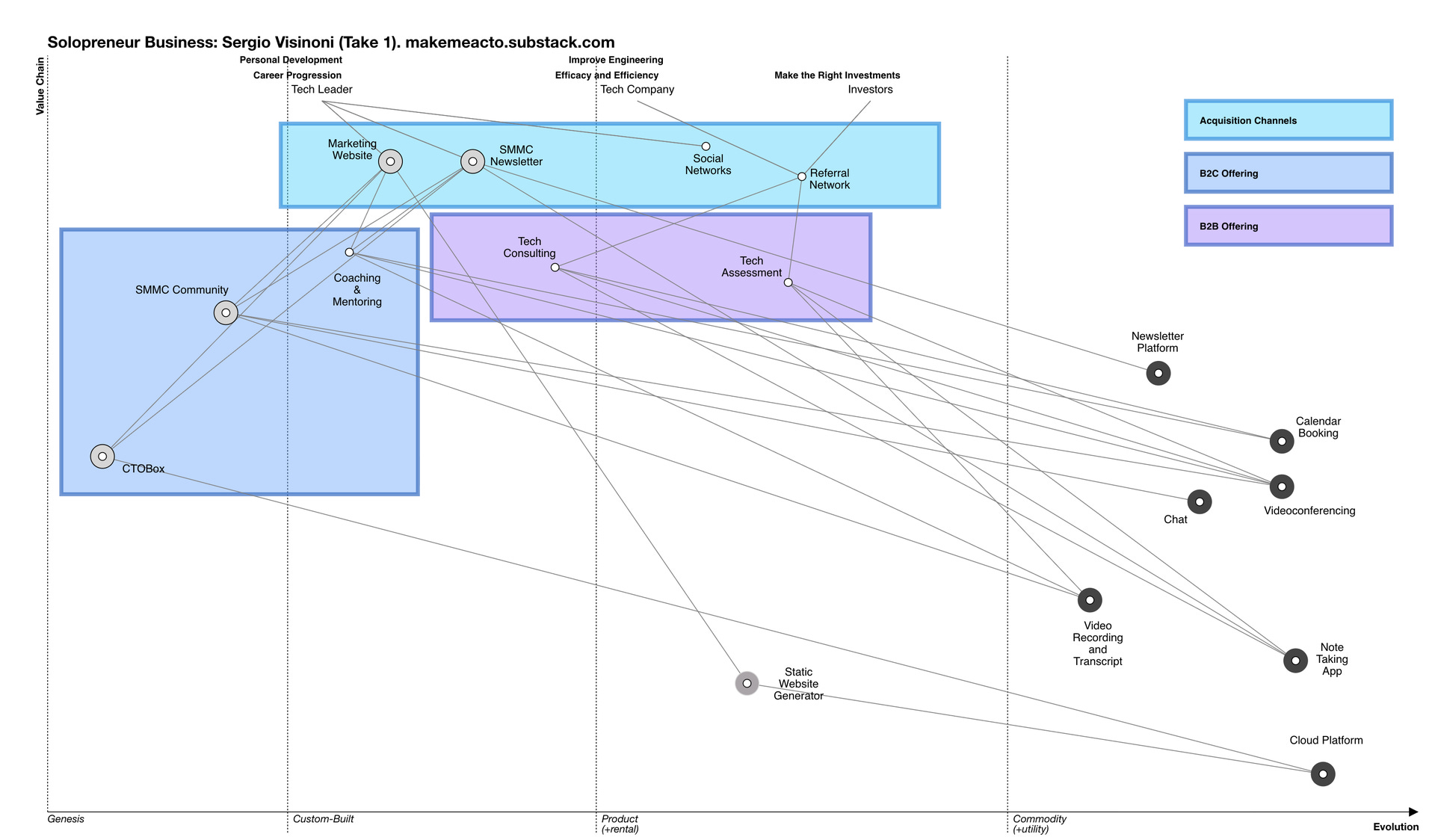
While it kind of made sense, I felt it was too noisy.
At some point, while staring at the map, I got the impression I was looking at a bird’s-eye view of a fishing competition, with crossing fishing lines into a sea of “something”.
I’m exaggerating a bit, of course, but the bottom line was that I wasn't satisfied with the result. Not surprisingly, if you think this was the first time ever I did such a map.
This first map, though, helped make me think more about the needs of the different client segments I’m trying to serve. It helped clarify the nature of the different services of products, but I felt there was a bit too much noise. Also, I wasn't completely satisfied with the generic Acquisition Channels at the top.
So I set out to try a different angle.
Another undisclosed amount of time went by, and then I got a second iteration that looked like this.
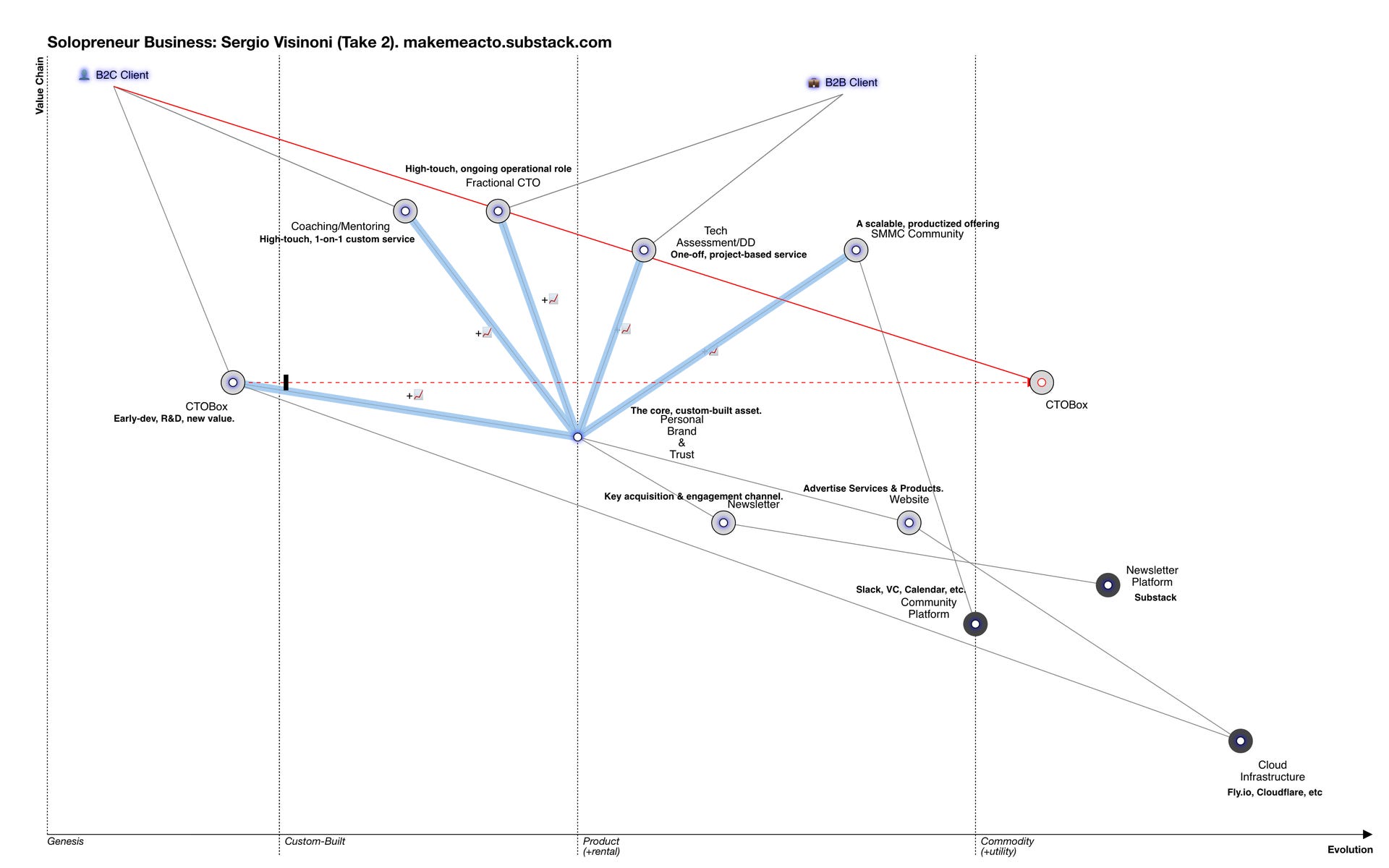
While I still don't think this is a perfect map, I found it a lot more helpful.
For once, it's less noisy and focuses on the important aspects. It also takes a different approach to viewing my personal brand as a key asset, which both strengthens my ability to sell services and is reinforced by every new engagement through referrals and recommendations.
The extra detail on showing the desired evolution of CTOBox from the early stage to becoming a commodity also helps illustrate the strategic direction.
I'll let this version settle for a bit before iterating further, as this is good enough for my current needs.
What’s next?
I’m aware that I’m barely scratching the surface here, but sometimes the hardest part is breaking the ice and making the first step.
After just a few hours of playing with it, I already had a much better understanding of Wardley maps than after merely consuming content about them. Dunning-Krueger caveat aside5, I’m starting to see how I could use this new tool in my work more consistently.
If you happen to read this as an expert practitioner, feel free to call out my shortcomings in the comment section. I’m well aware there is plenty I do not know yet about this subject.
As part of the self-education journey, I’ve published the two versions of the map in this public GitHub repository. You are free to have a look at it, as it might help you get started.
I want to take the opportunity to call out and give credit to Damon Skelhorn and his repository of Wardley mapping examples, which I’ve been consulting repeatedly as I was looking for inspiration and ways to address specific needs.
The immediate next steps for me involve the following:
Iterate on my business map as it evolves and as I gather a better understanding of it and of all the aspects of Wardley mapping, namely doctrine, landscape, and climate. I will keep updating the GitHub repo with subsequent versions of the map as I make progress6.
Use this presently less-unfamiliar tool in the client project I’m kicking off in the upcoming weeks, leveraging the opportunity to collaborate on the approach with other bright people. Learning together is more fun!
Strategy is an important aspect of my job, and I have a strong intuition that getting better at the practice of Wardley mapping will increase my ability to bring clarity and help clients - and myself - make better decisions.
Help keep this newsletter free
I love writing this newsletter, and I intend to keep it free forever.
If you want to support my work, you can engage with me in one of the following ways:
If you need help with your Startup, Company, or team, I can support through advisory or fractional services. Find out more on this page.
If you need personal support to overcome challenges and grow as an engineering leader, I can support you through Mentoring and Coaching. Find out more on this page.
If you are looking for continued support and the chance of joining a thriving community of like-minded people, I host a Community for engineering leaders. Find out more on this page.
If your needs fall into a different category, such as newsletter collaborations or sponsoring, please reply to this email or schedule a free call via this link.
Find out more about Somon Wardley on this Wikipedia page.
There has been a GitHub issue open since 2020, and it looks like someone has made a PR just a few days ago. I’m really looking forward to trying this out once it gets merged into the stable branch.
If you think I’m making fun of you, please consult this Wikipedia page. Dofgooding is a real thing, and it’s good for you.
If you just came here by accident, and have know idea about who I am, first of all, I don’t judge you. You are welcome. If you wanted to have more context about what I’m talking about in the following section, you might want to have a look at my website for an overview of the types of services I’m offering.
Yes, feel free to come back in 6-12 months from now and point out that I didn’t stick to this commitment. It happens from time to time.