

The Story of How I Got Into Leadership - Part 2
What tipped the scale for me, and some take aways you can use in your own decision on whether to transition to the Management track.

Hello readers,
In last week's post I shared the story of my first underwhelming encounter with management in the context of a big organisation.
At that point in my career I wasn't even thinking about the possibility of becoming a manager myself, for all the reasons detailed in that first article.
Today I'll tell you the story of what happened next. The story of how and why I decided that leadership was the right choice for my professional career.
Let's dive into it!
🌱 A better world is possible!
As I left the company I told you about last week and started at a new job, I was pleasantly surprised by three major improvements:
🥳 I shortened the length of the food pyramid above me.
I went from a situation with 4 hops between me and the actual client to a situation with only 3 hops! A 25% reduction of overhead in a single move sounds great, right?
🤓 I ended up joining a project where I found a lot of like-minded people.
They were both very competent and very fun to work with. The project focused on building Video over IP solutions for an innovative Telco. The team I joined was full of smart individuals with plenty of experience with Unix, Linux, Open Source and in general had a passion for software well built.
💪 I had a manager that was both very passionate and compassionate.
Humble and fun to work with. And most important of all, he seemed to care about me and my development. He spent a lot of time helping me navigate the technical details of the project.
Even more importantly, he taught me the art of navigating a complex organisation. As he had spent a long time in that company, he knew almost everyone and was able to help me understand how to deal with each one of them.
Last but not least: he was employed by the Client company, while I was a subcontractor… and he couldn't care less. He always treated me like everyone else, and evaluated me on the sole basis of my contributions.
I have very fond memories of the years spent on that project. I've learnt a lot from smart people, who were also very supportive and easy going. That whole experience started to change my mental model for what makes for a good manager in the tech field.
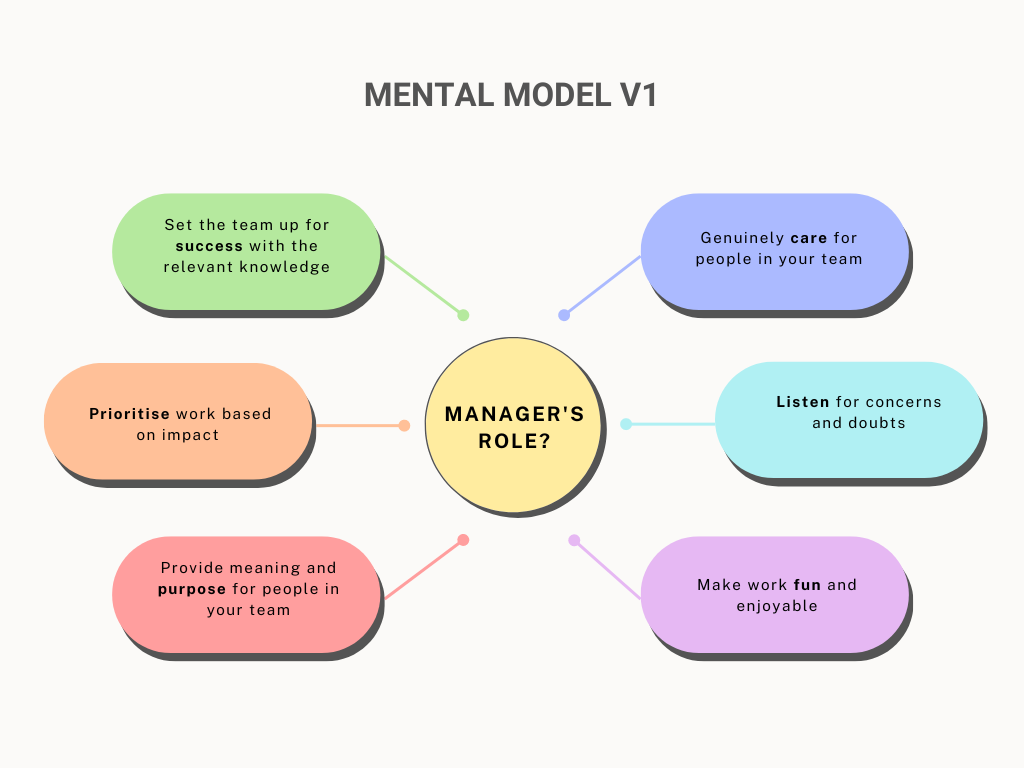
Though at the time there was still little awareness of frameworks, methodologies and processes to better structure the development of individuals, this new experience informed me that a good manager should focus on these key activities:
📖 Make sure the team has access to key knowledge to succeed at their job. Both technical and organisational.
🥇Help prioritise the work based on what's most impactful for the organisation.
💜 Give meaning and purpose to someone's work by letting them know how what they do contributes to the company success.
💁🏼 Genuinely care for the persons they're responsible for, ensuring they get the deserved visibility and opportunity for growth.
👂🏼Listen to concerns and doubts, and offer constructive perspectives and direct help, especially when dealing with other parts of the organisation.
😃 Make work fun and enjoyable, while still taking it very seriously.
We were getting somewhere!
The first opportunity to become a Manager
A couple of years after the positive experience mentioned above, I had the opportunity to join an international media group that was operating and launching marketplaces worldwide. Shortly after moving from the Italian to the French subsidiary of the group, I was offered the responsibility of the development team.
I had no idea what I was signing up for, but I loved the project so much and felt such a level of support from the leadership that I didn't think twice before accepting the offer!
This was the beginning of a rollercoaster that lasted almost 4 years, during which I had to learn the ropes of the job the hard way. Little training was available back then, and the role of an Engineering Manager was still very loosely defined in the industry.
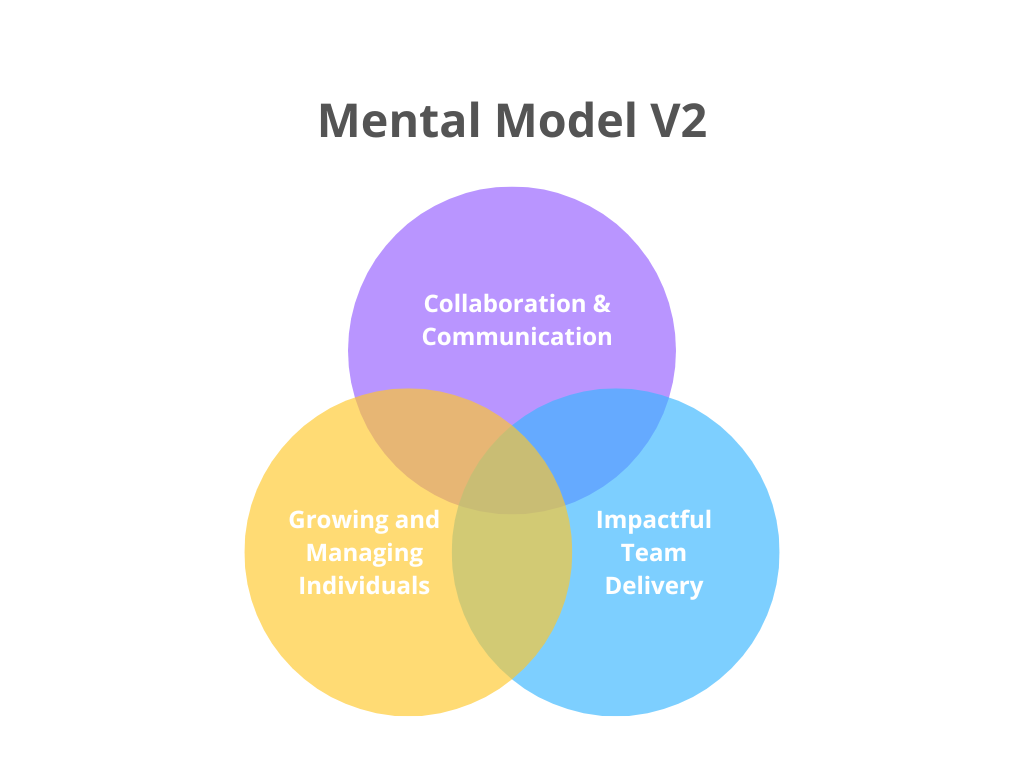
I had to learn the hard way, which led me to realise the following list of focus areas for the role:
🏗️ Ensuring the team can consistently deliver value. That includes processes, quality and balancing feature development with technical improvements.
💪 Growing and Managing individuals. That includes making sure people are provided with the right level of challenge and feedback. Balancing guidance and autonomy.
📡 Ensuring there is clear communication and effective collaboration with other teams and areas in the organisation.
These 4 years had been very intense. Despite the huge amount of professional growth and satisfaction, at this stage I was still regularly wondering if it wouldn't be preferable to just go back to being a software engineer.
So I decided to run an AB test.
🅰️🅱️ testing different options
At this point I felt I was tired of the role in leadership. I was also missing the hands on coding work that used to be the key activity in my job. So I decided to take on an opportunity to go back to full-time coding: I joined a team of experts on the marketplace platform as a full-time software engineer, and got to work on some very interesting problems.
I loved the first months. As time went on though I found myself more and more drawn to problems that weren't directly related with writing code, such as:
Planning work.
Suggesting improvements in our workflow.
dealing with conflicts in the team.
Communicating with key stakeholders.
The AB testing was surfacing a very interesting signal: though I did enjoy the intellectual challenge of working on complex technical problems, I realised I missed the joys and pains of working with the social and socio-technical aspects of software engineering.
And I missed it more than I missed coding when I was a manager.
So, when the opportunity came up again to jump back to the manager's track, the decision was an easy one.
Going all in on the Leadership track
I’ve been holding leadership roles that included managing teams ever since 2012.
As I progressed in the profession, I developed further interest in topics that are adjacent to Software Engineering, and have more to do with how humans behave and operates: behavioural psychology, organisational management, teams and individual's productivity, career development, etc.
I've also got myself more and more involved with topics related to operating and managing businesses, including the experience of being part of the board of directors for an Austrian marketplace.
I've come to believe that the main purpose of an engineering leader is to build highly effective teams. These teams in turn are responsible for building awesome systems and products.
This job isn't easy, and sometimes I miss the deterministic nature of machines.
But nothing beats the thrills and sense of accomplishment that I feel whenever I witness someone that used to be in my team moving to a leadership role and crushing it.
This is what led me recently to refocus my entire profession towards helping people and company achieving better engineering leadership, but that's the topic for another post.
Key Take-aways
Thanks for getting to the end of this two-parts series.
I hope my journey can help anyone that might be struggling with the decision of whether or not to move on to the manager's track.
If you strip away all the storytelling from my experience, here are the key take-aways that I hope will help you in your reflections:
Leadership is not for everyone. Luckily in today's world there are plenty of opportunities to grow as an expert.
Jumping back and forth between the manager and IC tracks should be encouraged, not frowned upon.
Observe what resonates with you more, what makes you proud. Try to filter out external expectations from your decision.
Understand what you're very good at, and double down there. Keep broadening your skills at the same time.
Find role models, they can be crucial in setting you up for success. Especially, do not let one bad experience bias your entire career.
Be the manager you'd always wanted to have. You can be a positive role model for a lot of people around you.
I hope you find this useful, and I'd love to hear about your own experience in the comments section!
Just one more thing…
You might be struggling right now with deciding between the IC track and the Manager track as I did back then.
You might have already moved to the Manager track, but struggling with some key challenges. I had to learn the job the hard way, and I believe an easier way is possible.
You might be a CEO or CTO that feel like you need to help your Engineering Leaders gain clarity and up their game. I have been working with teams of various sizes that needed to improve their leadership capabilities.
☎️ If any of these sounds like you, make sure to book a complimentary 30 minutes discovery call. I'd be delighted to analyse your situation and build a plan together on how to get there.
See you all next week with another issue of Sudo Make Me a CTO!