
Something Big is Happening #3
More reports on the impact of AI on software engineering, a look at the growing enshittification of digital products through AI, and how the tech industry is dealing with the climate crisis
You might have noticed a bit of delay in posting new articles lately. I've been busy with the migration to Ghost.io, and I'm glad to announce it has been completed1.
This is the first email you'll be receiving via Ghost, and I'll be monitoring the metrics in the upcoming days to make sure everything is in the right place. To celebrate this important move, this issue of Something Big Is Happening is available for free to all readers.
If you want to gain access to all past and future issues and support this newsletter, please consider upgrading to the paid tier.
Sudo Make Me a CTO is a reader-supported newsletter. If you enjoy the content and would like to see more of it in the future, please consider upgrading to a paid tier. Thanks in advance!
Second piece of housekeeping before we focus on this month's content. I'm happy to announce I've partnered with Codecrafters.io. In a time when most of the industry seems to disdain the art and craft of writing good code, I am impressed by Codecrafter's focus on deepening coding skills through non-trivial projects, such as building your own shell, DNS server, or Git.
I'm currently working through the Shell project in Rust, and it's a great way to learn the language with real projects and be able to compare my solutions with those of others. I can only recommend it. What's more, by using this link you'll be able to try it out for free and get 40% off your annual plan if you decide to upgrade. It's a great way to spend your learning budget!
Now, let's look at the ToC for this issue.
#1 New reports around the impact of AI in Software Engineering
#2 More open source projects pushing back on LLMs
#3 How AI accelerates enshittification
#4 Let's talk about the heatwave that's affecting Europe
#5 A little bit of fun to cheer you up
This is a packed issue, so let's start with the first item on the list right away
#1 New reports around the impact of AI in Software Engineering
We've often covered reports and papers assessing the impact of AI adoption in the software engineering lifecycle. Two new contributions were published in the last month, which we're going to cover here.
Faros.ai, a company in the AI telemetry space, released a report titled "The Acceleration Whiplash", which you can download from here 2.
The report is the result of a study across 22,000 companies using Faros to track the usage and impact of AI in their software development lifecycle. The findings are extremely interesting.
On the one hand, they're seeing a significant increase in the sheer volume of code created per unit of time. That's the acceleration part of the title. But, as the report calls out, there are two interesting signals.
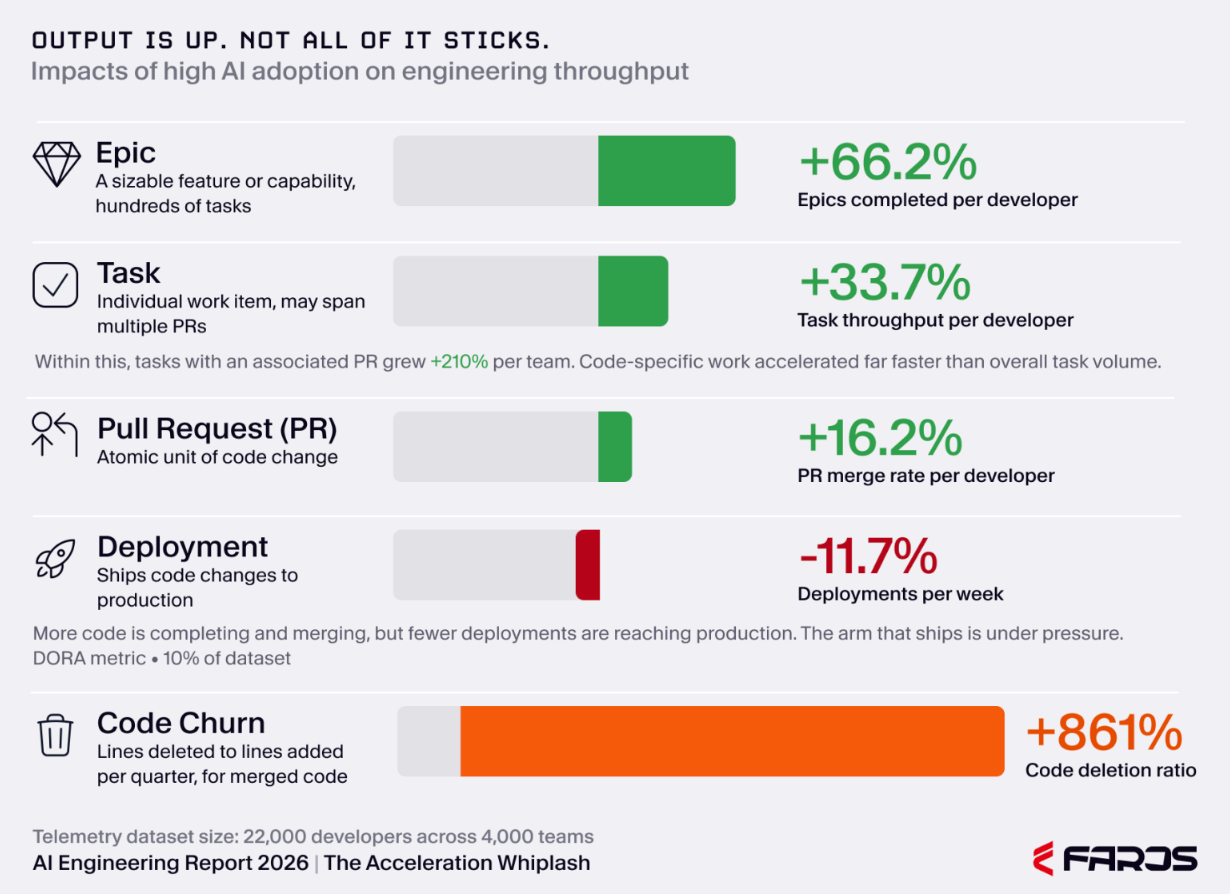
- Despite an increase of 33.7% in PRs, deployments per week are actually down by 11.7%.
- Code churn has increased by a whopping 861%, suggesting that a lot of those PRs might be just rewriting code previously authored by the same AI tools.
But there is more to it.
When I talk with companies that are willing to get all in with AI-assisted coding, I generally suggest they map out their bottlenecks first and try to understand what is really slowing down the delivery process before trying to optimise any specific step. This is rooted in Goldratt's Theory of Constraints3, something most companies prefer to ignore or simply forget. The Faros report seems to confirm that, as shown below.
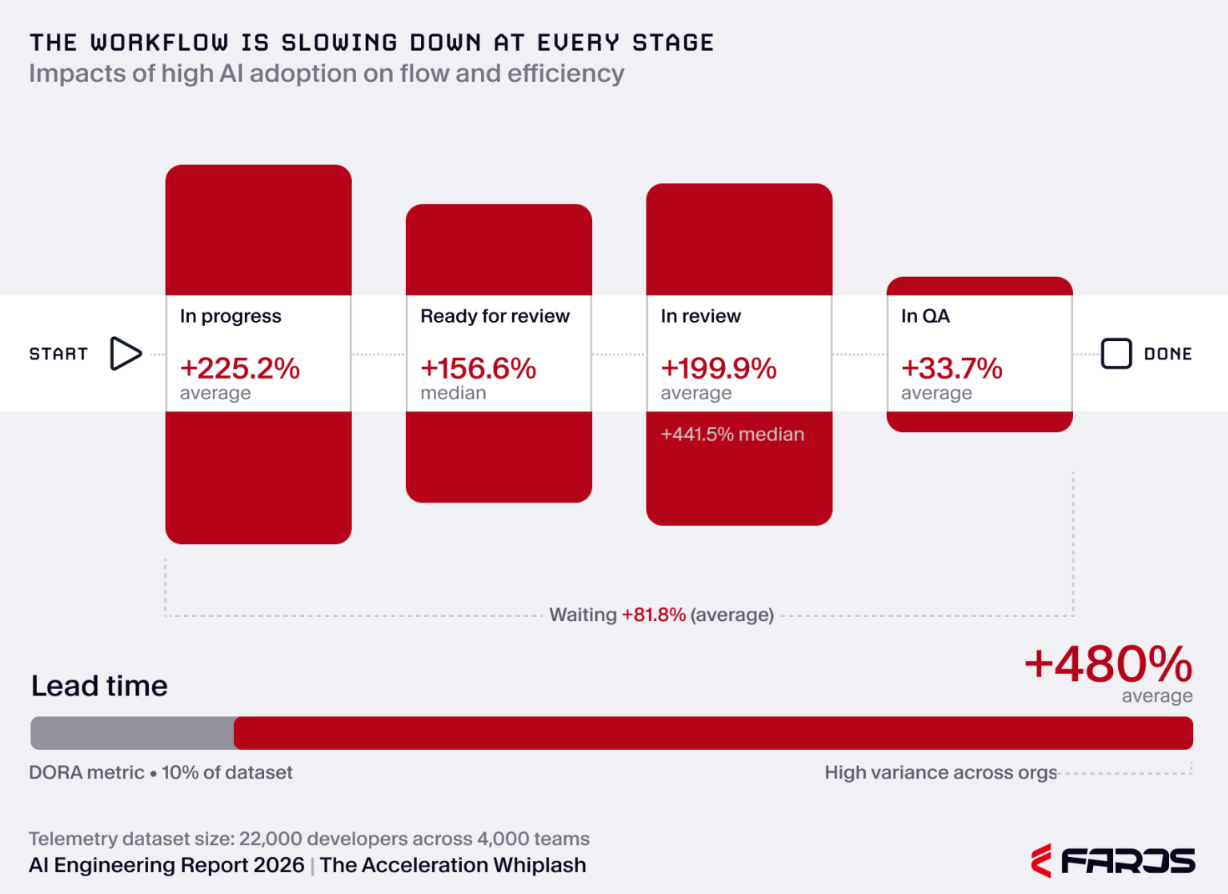
This seems quite self-evident, but I'd like to call out two specific aspects
- The 225.5% increase in the average time a task spends in progress is insane. It suggests too many in-progress items, a lot of rework, and a bottleneck being choked.
- The overall lead time is up by 480%. It takes about 5 times longer to ship value to users!
You might wonder if this is a case of slowing down in order to improve quality, but the available evidence points at the opposite effect.
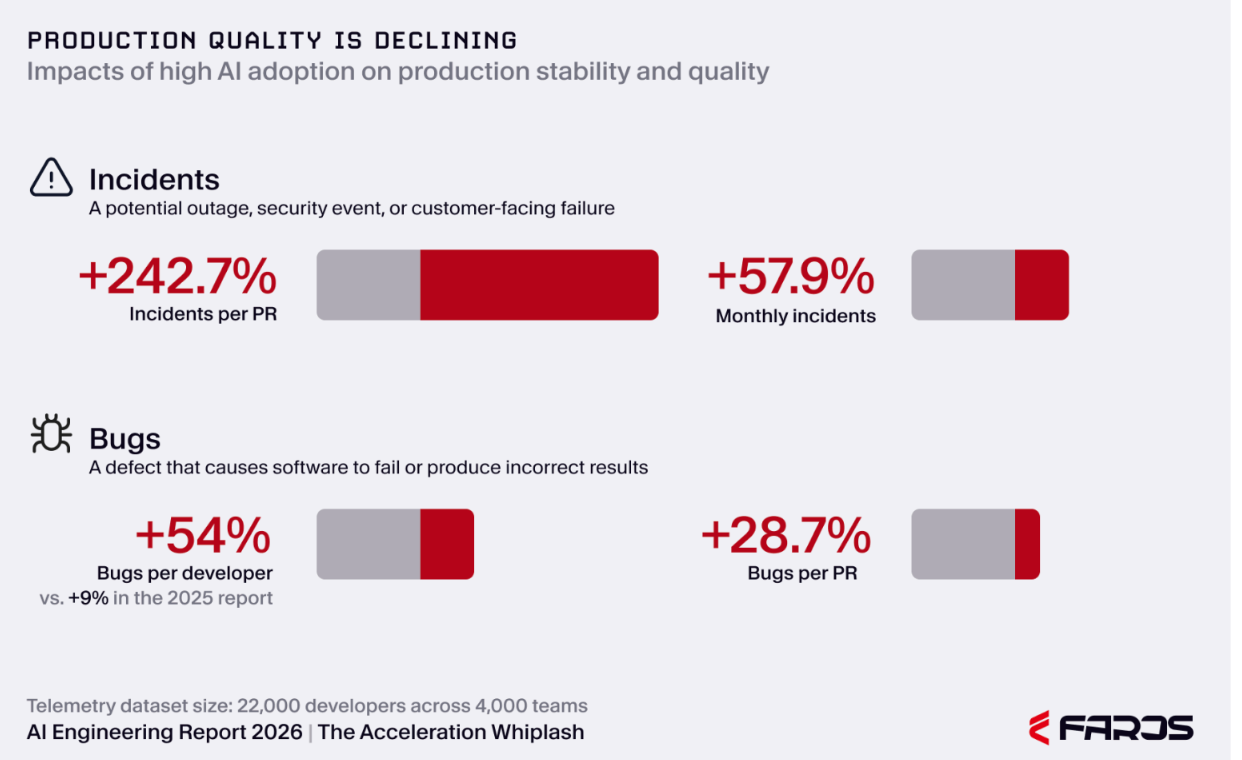
So, not only does it take 5 times longer to ship value to the user, but we're also seeing the following:
- A 2.5x increase in incidents per PR. Yes, per PR, whose number has also increased.
- About 28% more bugs per PR.
In summary, based on the study on these 22,000 companies, AI increases the sheer volume of code created all the while making it harder to ship value to end users, whose experience is massively disrupted by more incidents and bugs.
Time to reconsider the approach?
The Faros report contains some other interesting findings around cognitive load, etc. I do recommend it, and I suggest you circulate it within your company to help feed an honest discussion.
Also in May, an interesting working paper (not yet peer reviewed) has been released: Writing Code vs Shipping Code: Productivity Effects Across Generations of AI Coding Tools4
It focuses on the same problem, from a slightly different angle, reaching a very similar conclusion: Large task-level AI productivity gains have therefore translated only partially into shipped and used software thus far.
The paper is also looking at what the authors call the 'bottleneck hypothesis'.
A prominent argument is the bottleneck hypothesis, or weak links: AI may be highly productive at specific tasks, but overall output is limited by complementary tasks that are still performed by humans whose productivity is unchanged (Kremer, 1993; Jones, 2011, 2026).
The whole paper is an interesting read, but if we wanted to boil it down to the two main conclusions, they're the following:
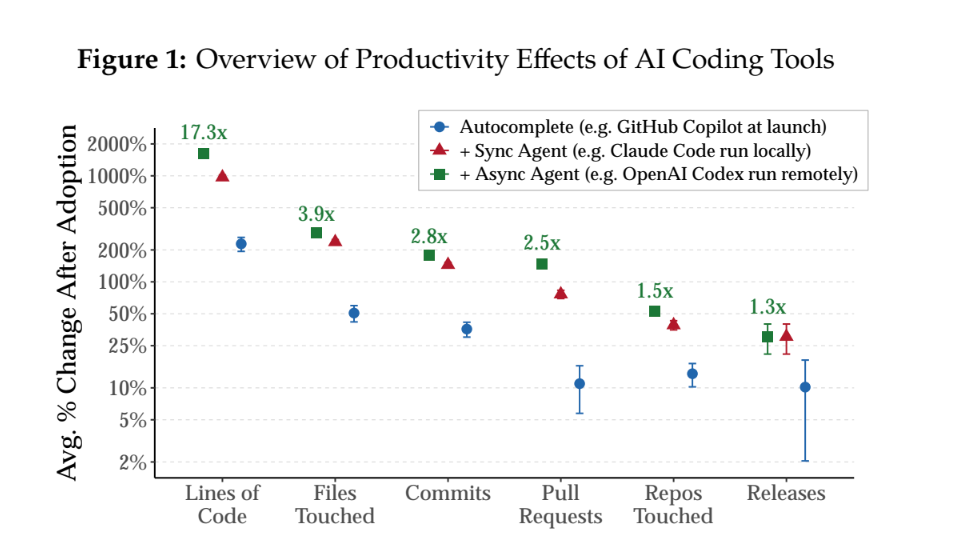
Task-level productivity gains show progressively attenuated effects in the following steps in the pipeline leading to shipping value to the end user. This is consistent across different generations of AI-coding tools, from the early autocomplete to the more recent autonomous agentic workflows. What the authors call sync agents show the best results summarised as follows.
Sync agents lead to a 741% increase in lines of code and a 65% increase in pull requests, yet releases rise by only 20%.
It's interesting to note that while the Faros report found a decrease in release frequency, this paper, whose sample included almost exclusively public GitHub projects, found an increase. Both findings, though, seem to align on the fact that the bottleneck is no longer, or has never been, in the act of pure code production. Yet, that's what most companies are still focusing on.
The second finding is equally interesting
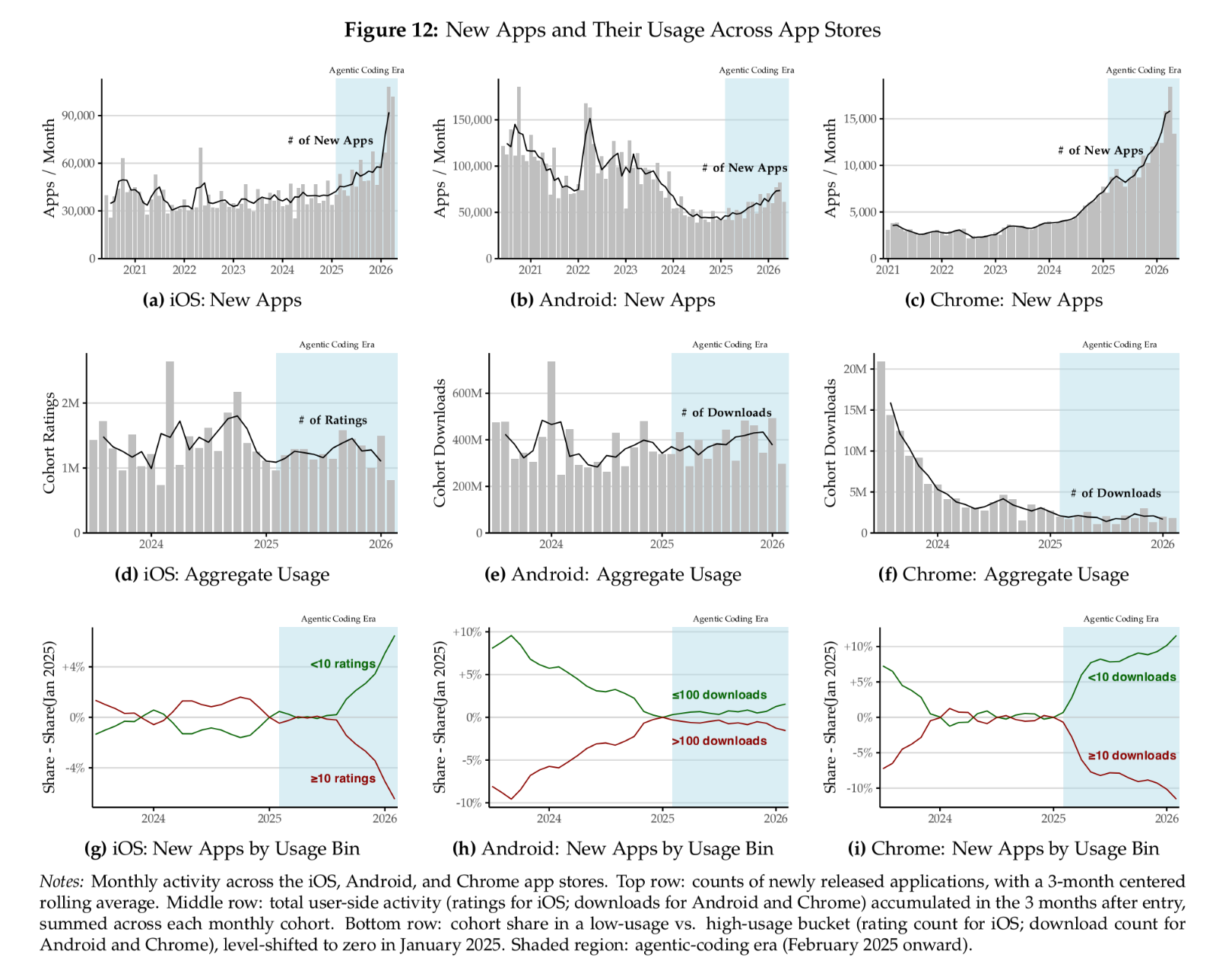
In essence, it finally looks like we're seeing some of the showelware5 showing up. But, while this might indicate a positive impact of agentic AI, as it seems to translate into more Android, iOS and Chrome apps, this signal is strongly mitigated by the usage data. In essence, and according to the authors of the paper, most if not all of the additional apps published get little to no usage. The reasons aren't evident from the study, and one can speculate that these new apps are low-quality, that the challenge is in distribution, or a combination of the two.
What's clear, once more, is that it is currently very hard, or close to impossible, to identify positive business results tied to AI adoption in the software development lifecycle. In other words, while building good products is still very hard, AI seems to be making it a lot easier to build average, mediocre, just bad products. As we'll see later, AI might just be an accelerator for enshittification, or
With x being the multiplication factor commonly associated with bold claims, such as in 10x productivity gains.
#2 More open-source projects pushing back on LLMs
Last month we covered how Linus Torvalds was getting annoyed, in the typical Linusian way, about LLM-authored contributions that were negatively affecting the development process for the Linux kernel.
 Sergio Visinoni
This time around we're looking at another major open source project taking a stance on LLM-authored submissions: the Rust language project.
Rust has been steadily growing in popularity over the past decade. One side effect of its strict compiler is that it's emerging as a good fit for AI-assisted development. As the compiler provides detailed feedback and enforces correctness in the implementation, it provides valuable feedback to AI agents in guiding them towards a working solution. A lot more so than most, if not all, other languages. That has backfired, as the project has been flooded by low-quality LLM-generated PRs, effectively choking the already bottlenecked review process6.
By June 2026 this is hardly news, as we've seen this problem time and again affecting all popular OSS projects. What's interesting is that the Rust community, after months of debates, has finally reached a conclusion on how to address the issue, and published it in its LLM Usage Policy
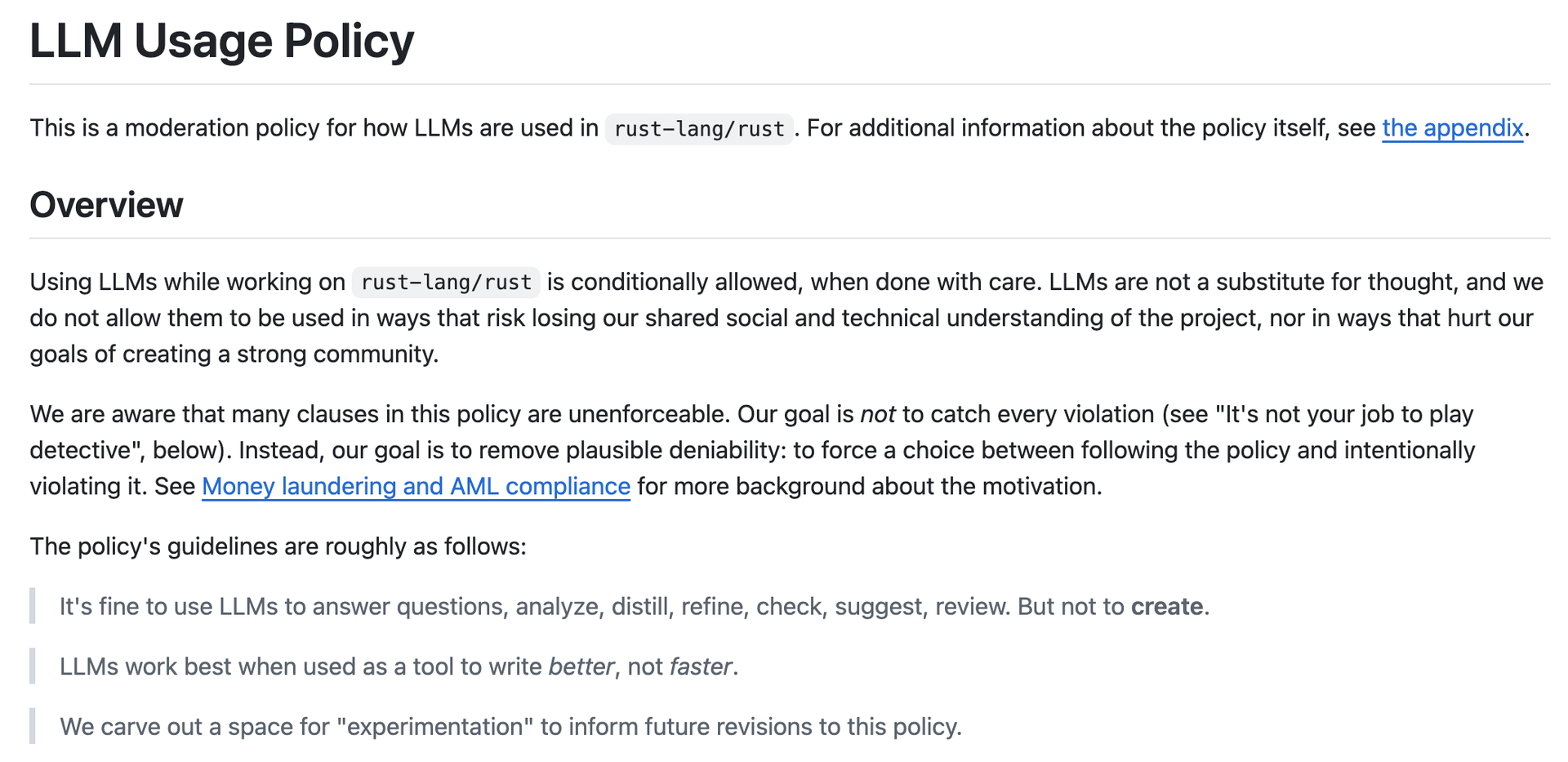
The part that stands out for me is the second bullet of the policy summary.
LLMs work best when used as a tool to write better, not faster.
You might have seen many people defending the use of LLMs unconditionally by saying that there are good and bad ways of using them. They tend to ignore ethical concerns, and for the sake of this exercise I'll also ignore them (but come back to it in later points).
People who promote the idea of the user being in full control of how the tool is used, that bad usages are only to be imputed to bad actors, ultimately do that from a first principle that sees technologies as being inherently neutral. I'll focus more on the fact that philosophically the debate between technology neutrality and determinism is still very much open in an upcoming article, but it's just worth mentioning here something interesting.
I'll look at the emergent behaviours as a proxy for the characteristics of the underlying system.
Let's then look at the facts. Reports and papers such as the ones mentioned above seem to indicate that, perhaps due to wrong incentives, beliefs in the propaganda, or other reasons, the general tendency is to use AI to go faster, not to build better products, code, or services. That is the emergent behaviour of AI usage.
The fact that more and more open-source projects need to resort to policies to counter that and regulate their usage to only allow the good ones is a further indicator of the need to counter "natural" tendencies with corrective actions. In other words, left to their own devices and equipped with this new technology, the dominant (in effect) behaviour emerging among contributors is a bad one: flooding a crucial project (for humanity) with a lot of slop in the hope of perhaps gaining some popularity. They try to take the fast lane instead of the slow one, the one which requires rigour and dedication, as they see that more aligned with the system they perform in.
Pointing the finger at individuals behaving in such a way, rather than looking at the system's incentive, is akin to saying that people kill other people, not guns, while ignoring the impact of guns' accessibility on the rate of homicides.
In other words, the fact that a growing number of projects need to actively regulate the use of LLMs, something unprecedented with any introduction of prior technologies, should not be taken as a sign that the rate of bad actors has somewhat increased. It is to be taken as a signal that this specific technology, for reasons that require deep studies and scrutiny, is incentivising such bad behaviour to such an extent that it has to be regulated.
That said, I'm planning to come back to this specific topic of technology neutrality soon, as I'm educating myself on the topic and generally have a hard time taking it at face value, as the evidence seems to disprove it in many, but not all, cases.
In the meantime, I'm happy about the Rust community decision to value quality over speed, and I believe their policy is a great example of setting boundaries without accusing, blaming or otherwise making anyone guilty. One more reason to continue dipping my toes into the language7.
#3 How AI accelerates enshittification
On the Enshittification front, here is a list of recent events that I find exemplary of how AI is accelerating the shift into building worse products, services, and overall human interactions.
Most of them come from the great folks over at 404 Media, an independent investigative journalist firm doing a great job at reporting about all the worst the tech industry has to offer.
The first one is a case that would be hilarious if it weren't true. The lawyers on both sides of a federal court case in Mississippi were caught using AI. Fortunately, the judge Sharion Aycock went ballistic on both of them by pausing the proceedings, cancelling the trial and, more importantly, disqualifying all four lawyers involved in the case. Not only that, but all lawyers received fines of between $1000 and $3500. I guess they might use ChatGPT to appeal those fines.
The second one is a bit more light-hearted but highlights what looks like an increasing alienation and distancing between tech executives and their employees 8. While Sundar Pichai recently announced that 75% of the company's code is now AI-generated, employees at the company are increasingly sharing memes about how bad their internal AI-assistant coding tool, named JetSky, is. While executives seem to be only interested in vanity metrics and raw speed, employees are the only ones still caring about the quality of the work being produced.
The third one should get everyone freaked out, as Microsoft has been saying the quiet part out loud in an internal strategy document for their "Scout" personal assistant: they want to make it addictive. Yes, they're using the language of addiction explicitly and framing that as something positive, a goal to achieve. Scout is supposed to be an always-on personal assistant based on OpenClaw. Its three-phase launch plan starts with Phase 1: "Make people addicted". The cherry on top, as the article points out, is that Nadella himself said at a previous conference that Microsoft would never ship OpenClaw, as "that would be considered Microsoft launching a virus." If anything, AI is succeeding in accelerating the speed at which tech executives make fools of themselves by saying one thing and doing its opposite shortly after.
The fourth exhibit comes from my direct experience. As part of my consulting work, I regularly need to review and sign agreements with clients. It's standard practice, and though I find it boring as hell, I was taught from a young age to read documents carefully before putting my signature on them. Last week I had just to review one such agreement, and it came via Docusign, as that's often the case. To my surprise, when I clicked on the link to open the document, this modal appeared on the side of the screen, nudging me into doing the stupidest thing ever:
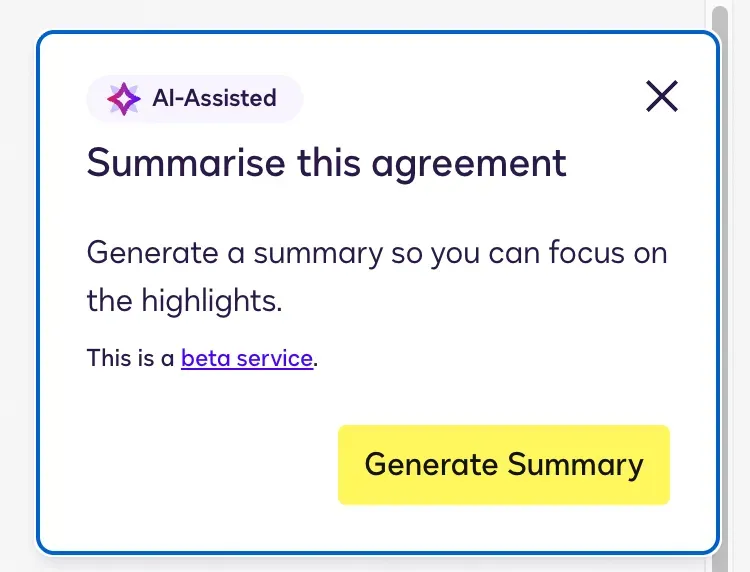
As I posted quickly on BlueSky, this tells me Docusign is completely desperate and probably lost forever.
Let's just spell out what is happening here. Docusing is a company that built a strong brand and reputation in the space of legal agreements. Legal agreements are those kinds of documents where every single detail, word, and comma matters significantly. While everyone hopes for the best, the reason why an agreement among parties is signed is that, if things go south, you'll be held accountable to each and every word appearing in the agreement you signed. This is the last place on earth where you'll want an unreliable technology with a propensity to make up things that don't exist to summarise the content for you.
Do. Not. Do. That. Ever.
And the "This is a beta service" only makes things worse. It's not a waiver of responsibility; it's an admission of the recklessness of putting a very dangerous, potentially toxic material in the hands of your valuable customers without even applying the required rigour to make it sound. If signing an agreement based on a summary is a very high-risk decision, doing that when the summary is generated by a beta product makes it exponentially more risky.
Why on earth should anyone accept the risk of serious personal and professional consequences just to help a company that seems to have lost its mind test an unfinished product? Are laziness and recklessness the kind of behaviours that a company operating in a legal space should incentivise?
Such products should be an immediate career-ending event for everyone involved, starting from the board of directors or anyone else who's creating the wicked incentives for something like this to happen.
#4 Let's talk about the heatwave that's affecting Europe
In this issue I won't focus on the financial aspect of the GenAI industry, though I do recommend you read this recent article by Cory Doctorow and bookmark this helpful website, which keeps track of the balance on a monthly basis. A great initiative in transparency for an industry that has opacity as its core.
Instead, I want to take the opportunity of the dramatic heatwave that is hitting Europe as I'm writing these words to review where we are with the promise of AI solving the climate crisis9.
We'll be looking at two pieces of evidence showing us how, in fact, as of June 2026, 4+ years into massive investments into the technology, the only measurable impact to the climate made by AI is in the direction of making things significantly worse. Let's start with a bit of news from around the infamous arms race between the USA and China10.
In what will probably go down in history as the most unfortunate trend of the decade, I'm sad to report that as of 2026 the US is investing more in fossil fuel than China.
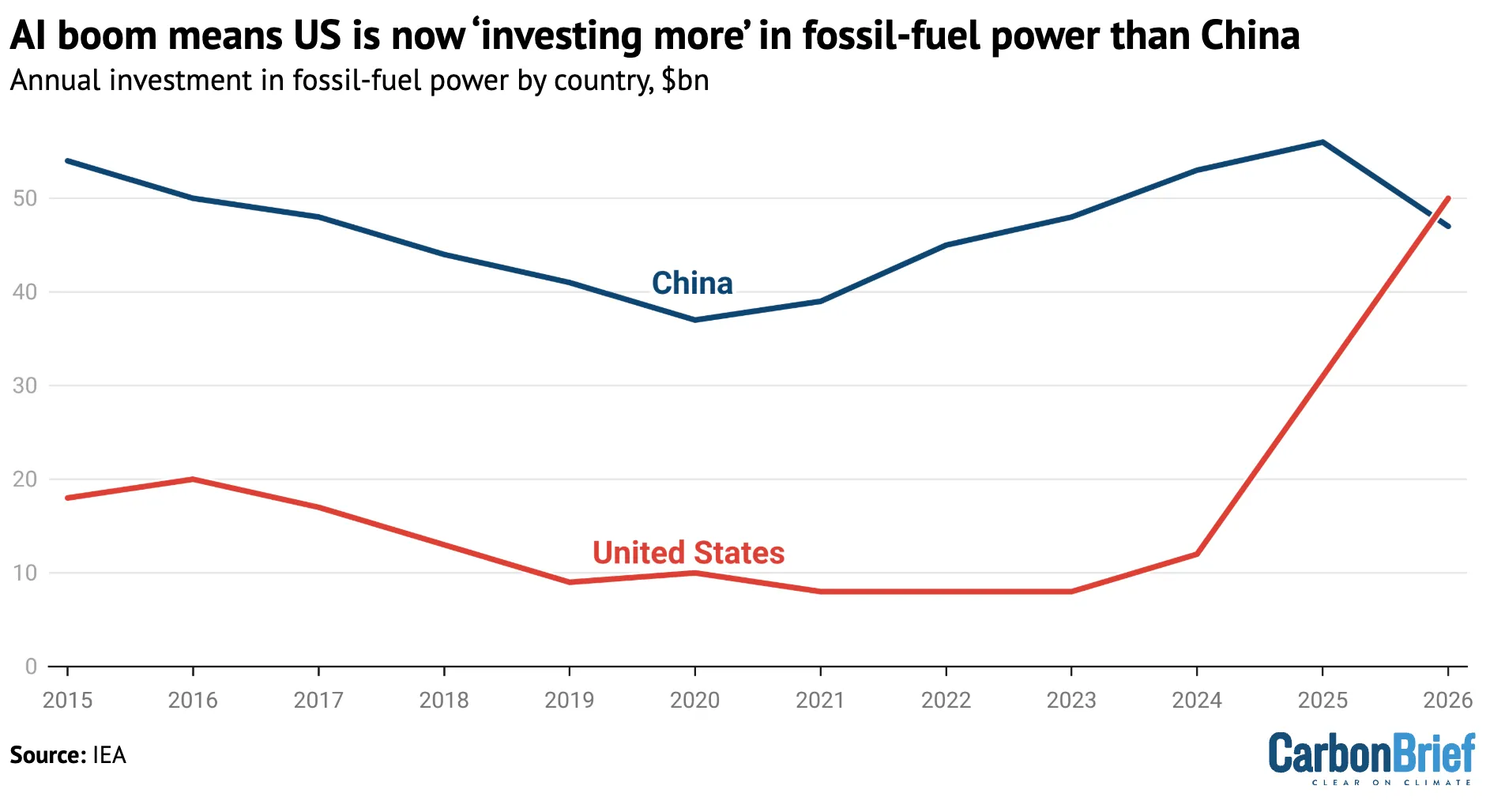
That is the total investment in billions per country. Now, for the sake of the exercise, remind yourself that China has about 4x the population of the US. Then reimagine that graph in terms of per-capita spending and feel the indignation, scorn, and repulsion at the image it pictures. It is really disgusting.
You might be tempted to brush it off by attributing the madness to Trump's political agenda and assume AI development has very little to do with it. Not so fast.
It turns out, to quote the article, that since the start of 2025 these US captive data centres alone have signed off on more investment in new gas turbines than any country in the world – aside from the US itself.
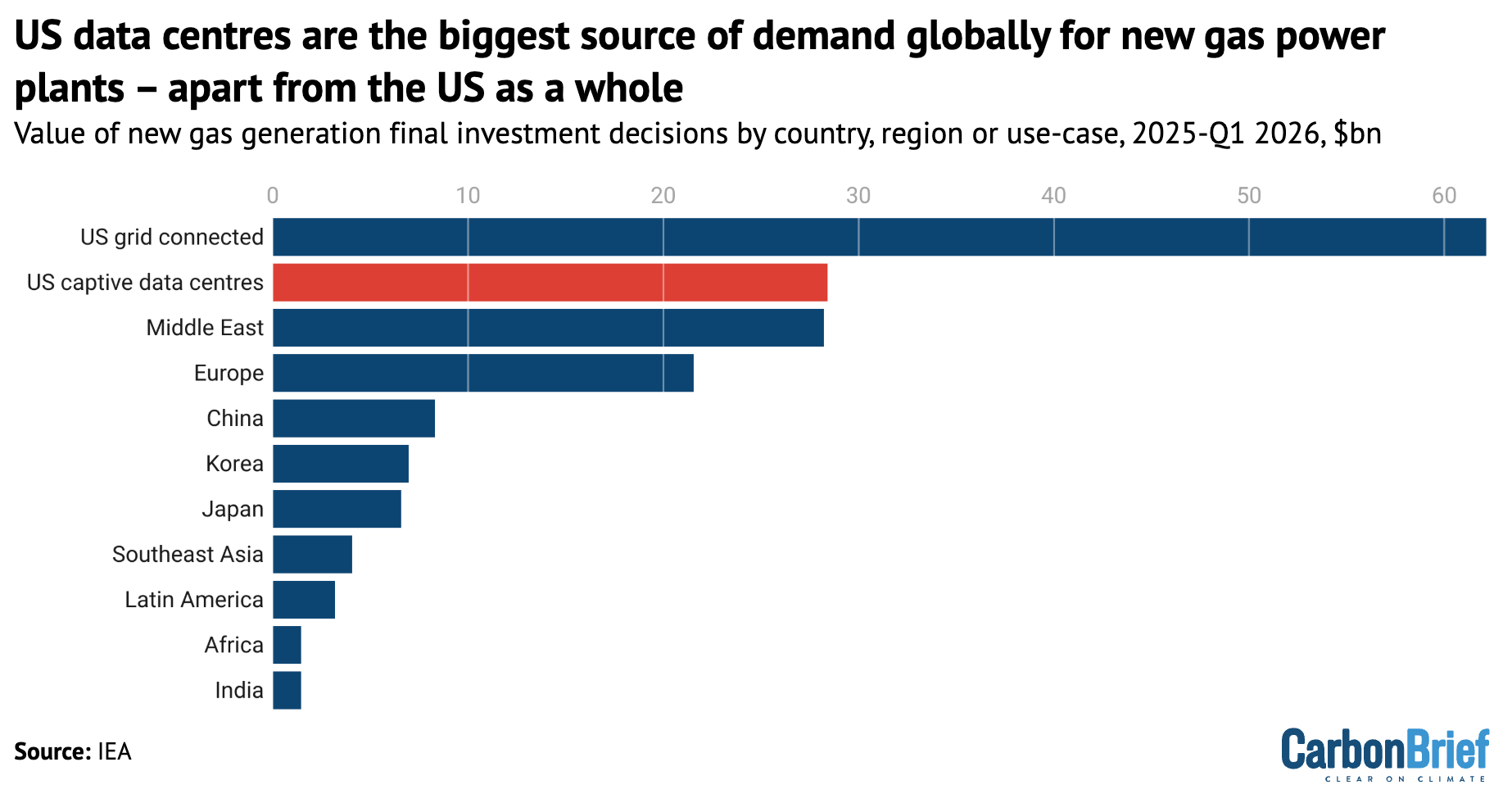
If you're interested in the topic, I suggest browsing the original report from IEA. I found it particularly interesting to look at the disproportionate difference in investments in low-emission electricity in regions such as China and the EU compared to the US.
While discussions about individual data centres can often be dismissed as being anecdotal and representing an exception, reports such as the one from the IEA show the big picture. And it looks bad. How bad?
Let's shift our attention to Europe, where the death toll from the heatwave has reached alarming levels11. In what should be our Don't Look Up moment, some voices still dare to suggest we should just look away and focus on filling our pockets as quickly as possible.
One of those is Lex Coors, a person I ignored until recently but who I don't hesitate to describe as despicable. He's the president of the European Data Centre Association, whose main goal seems to be lobbying at the EU level to promote the interests of data centre companies across the Union12.
According to a chilling article by Politico, Coors is suggesting that the EU should consider allowing the construction of fuelled datacentres to prevent the risks of delays caused by the green energy infrastructure's readiness. Coors' suggestion to at least "open up the conversation" reeks of recklessness and lacks any form of human decency.
To put it in the words of a spokesperson from Greenpeace EU, "The idea that the EU's too-slow progress on climate should be further sacrificed by burning more gas for the sake of tech bro profits is preposterous."
If not even the worst heatwave in European history seems to deter greed-driven interests in this space, this industry has no credibility left. The shameless lack of responsibility has reached peak levels. I do hope that the lobbying power of Coors' association will not be strong enough to open up the conversation to even consider such an aberration, but I wouldn't bet on it, unfortunately.
#5 A little bit of fun to cheer you up
In a world that seems determined to consistently accelerate the amount of shit produced and sold as gold (the ultimate alchemist-mentalist trick), we should continue to resist. Art, humour, and fun are good ways to show that we'll go down fighting or dancing. Here are a couple of examples to follow. Their authors deserve all the support you can spare.
- Andrew Singleton recently published a great piece trying to explain AI economics for dummies with analogies even a 5-year-old could understand.
- Asher Perlman has written a very subtle article in defence of AI art. It's worth reading attentively, as you might be misguided in your first impression.
- Lastly, I'm pretty sure you've heard about the wave of commencement speeches being booed as they tried to sell the AI-is-the-future-get-onboard narrative to recent graduates. In this flood of failed speeches, you might have lost one that got cheered. Despite the hyperbolic and coloured language, I showed it to my kids a few times over, as I think it deserves space. I didn't know about Ronny Chieng prior to this, but I can only appreciate his talent as a comedian who is able to talk about serious topics in a provocative way. You can find the full speech he delivered at Harvard here or a clipped-down version below.
These are all good examples of how we can have fun resisting. I'm looking to see more examples of that as more people mature and take an ethical and political stance on the topic of how GenAI is being used and deployed.
If you know of more examples, please share them!
If you're interested in why I've decided to move away from Substack, you can read more about the reasoning here. ↩
Yes, it's the annoying lead magnet form where they want you to give up your soul to download the report. If you don't want to go through that, just hit me up and I'll send you the PDF. It's a good read, I recommend it↩
If you're unfamiliar with it, read up my review of the book "The Goal" by Goldratt here↩
By Mert Demirer, Leon Musolff & Liyuan Yang. You can download the full PDF at this address.↩
This term is a reference to an important and influential article by Mike Judge, published in September 2025, titled Where's the Shovelware? Why AI Coding Claims Don't Add Up. In it, Judge made the valuable point that we were not seeing any increase in apps published or domains registered despite multiple years of claims of productivity improvements.↩
Have you noticed how the issue of bottlenecks keeps coming up? You're a good reader.↩
BTW, I'll be attending the upcoming EuroRust 26 in October here in Barcelona. If any of my readers are also coming, please hit me up. It would be great to meet IRL!↩
The article is paywalled, but the same topic has been covered in a recent podcast episode that you can find here.↩
I never believed for a second in the promise, but it's a fact that Sam Altman made it publicly.↩
I am far from being a fan of Xi Jinping, but China surpassed the USA when it came to both technological and environmental contributions a long time ago.↩
It always surprises me when someone, when faced with such a human tragedy, worries about the impacts on economic productivity.↩
Those companies include Microsoft, Google and Amazon.↩


Comments ()