
📚 Books I read in June 2026
June brought me an insightful book to better understand the current macroeconomic context and the role Big Tech plays in it, complemented by 3 engaging sci-fi books, each one with its own different style.
Here we are with the June edition of the books I read last month! If you end up reading one of them, please let me know!
As a reminder, all links in this issue will point to the books' pages on HardCover via a referral link.
If you want to quickly access all the book reviews I've been publishing since March 2024, here's a convenient link you might want to... bookmark (pun intended).
Sudo Make Me a CTO is a reader-supported newsletter. If you enjoy the content and would like to see more of it in the future, please consider upgrading to a paid tier. Thanks in advance!
💫 Book Highlight: Techno Feudalism by Yanis Varoufakis
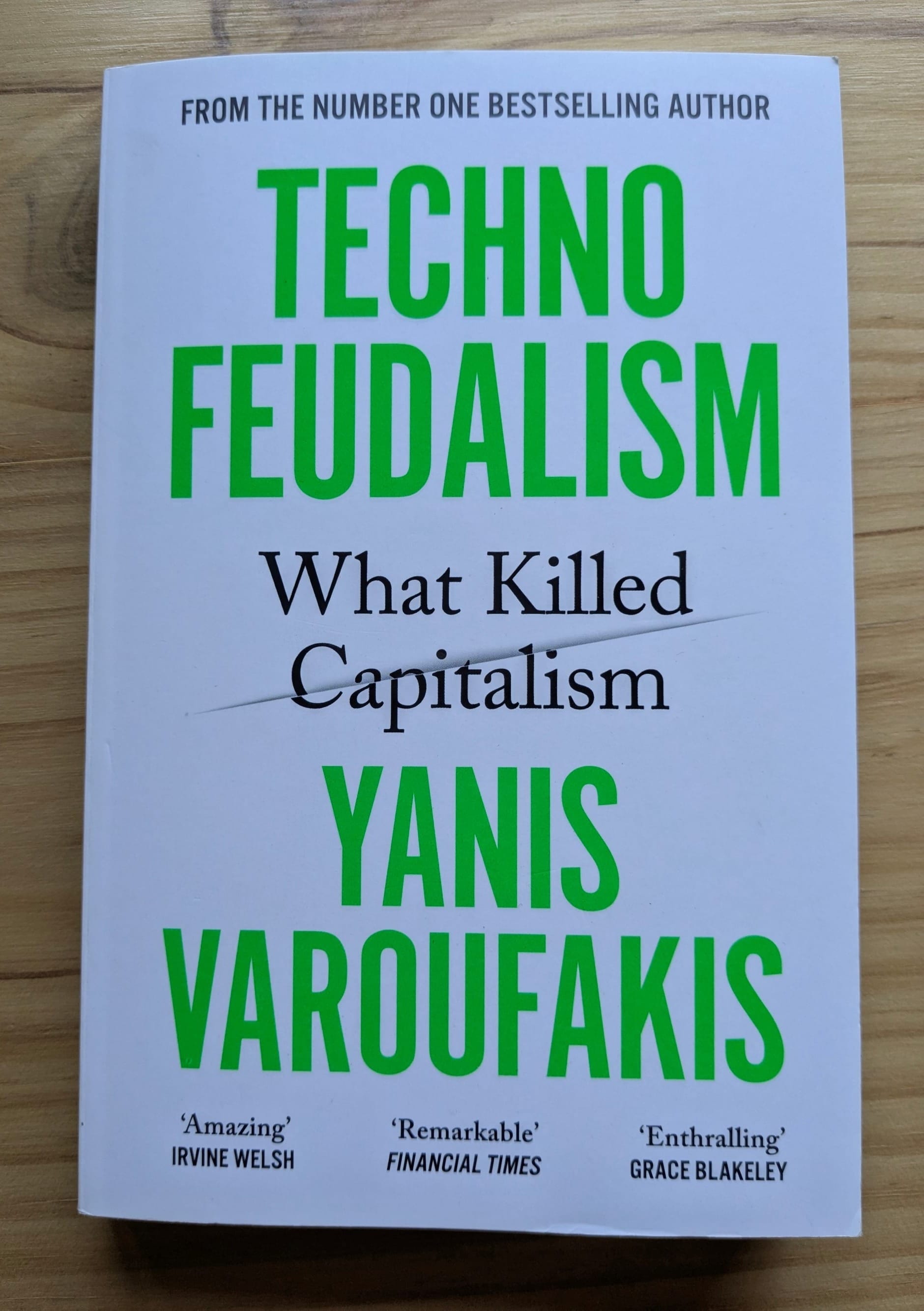
Techno Feudalism, by Yanis Varoufakis
281 pages, First Published: January 1st, 2023
I discovered the existence of this book while reading Cory Doctorow's Enshittification in February.
 Sergio Visinoni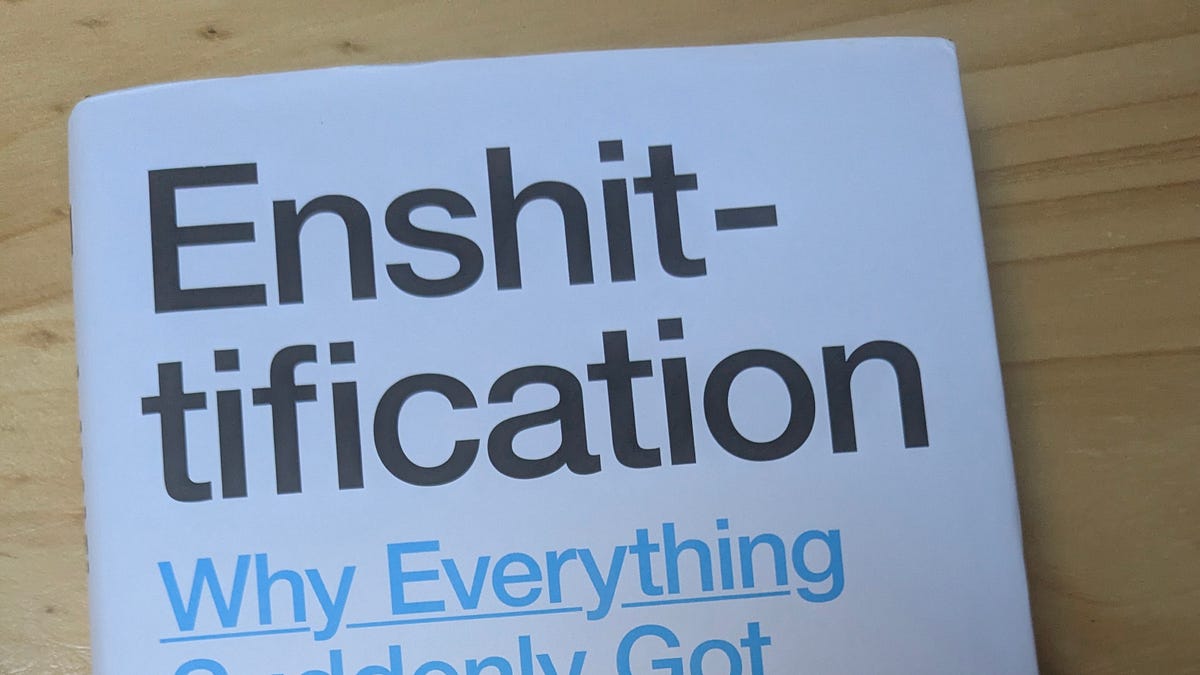
I must admit that until recently I had only a vague idea about who Yanis Varoufakis was. For those in a similar situation, here's a quick summary. He's a Greek economics professor, author and politician, mostly known for having been the CFO at Valve and the minister of economy in Greece in 2015. He defines himself as a libertarian Marxist so that there's little doubt about the origin of his ideas and theories. 1
The core thesis of this book is that the advent of Big Tech has ushered capitalism into a post-capitalistic phase, one he defines as 'techno-feudalism'.
He makes his point based on the fact that capitalism had emerged as a contrast with the feudalism system, which was based on land ownership and rents. Capitalists abhorred the idea of rent and preferred what they considered a more meritocratic system based on rewarding those who produced valuable products. Capitalists would own the means of production and sell the produced goods on the free market.
Varoufakis' thesis is that the cloud-based economic system we all interact with on a daily basis is based on ownership of "digital land" and extracting rents from it. What's more, traditional capitalists who want to continue selling goods are forced to pay rents to the cloud capitalists in order to perform their job, as they have substituted free markets with monopolistic fiefdoms.
And it doesn't stop there. Varoufakis also introduces the notions of cloud proles and cloud serfs.
While the former are best exemplified by the Amazon warehouse workers, the modern-day proletariats in service of cloud capital, the latter are a lot more subtle and specific to the current age. Varoufakis argues that we have all become cloud serfs, as we're essentially working for these conglomerates for free by producing content, uploading pictures, writing reviews, and otherwise engaging with those platforms.
And yet all of this would be worthless without 'content'. The most valuable part of the stock of cloud capital is not its physical components but rather the stories posted on Facebook, the videos uploaded to TikTok and YouTube, the photos on Instagram, the jokes and insults on Twitter, the reviews on Amazon, or, simply, our movement through space, allowing our phones to alert Google Maps to the latest spot of traffic. In providing these stories, videos, photos, jokes and movements, it is we who produce and reproduce – outside any market – the stock of cloud capital.
[...]
The fact that we do so voluntarily, happily even, does not detract from the fact that we are unpaid manufacturers – cloud serves wholse daily self-directed toil enriches a tiny band of multi-billionaires residing mostly in California or Shanghai.
Varoufakis believes this is the crux of what makes cloud capitalism different from traditional capitalism, as it impacts at its core the way it reproduces itself.
The true revolution cloud capital has inflicted on humanity is the conversion of billions of us into willing cloud serfs volunteering to labour for nothing to reproduce cloud capital for the benefit of its owners.
The book covers detailed aspects of the economic history of the 20th and 21st centuries that explain the rise of cloud capital, in particular as a consequence of all central banks printing money like crazy at the outset of the 2008 subprime financial crisis. It explores the interdependencies and the differences between the US and the Chinese and also touches on the biggest crisis humanity is facing: climate change.
Speaking of miracles: given capitalism's inherent tendency to deplete the commons, it was always going to take an enormous one for our species to escape climate catastrophe. Technofeudalism's advance makes this miracle even more improbable. The Age of Cloud Capital erects two obstacles in the path of climate change amelioration. One obstacle operates at the level of politics and is obvious. A grand deal between the United States, the European Union, China (not to mention Brazil, Russia, India and South Africa) is a prerequisite for limiting climate warming to levels consistent with our species' survival.
In the shadows of this New Cold War [Between US and China, NdR], the best we can now hope for are two separate green transitions, one in each super cloud fief – a bifurcation of the global green agenda which, I fear, will play into the hands of fossil fuel conglomerates who will find ways to play one off against the other, allowing them to keep drilling.
Technofeudalism was published in 2024, but this prediction is coming true already, as we've learned from the last Something Big Is Happening issue.
 Sergio Visinoni
Which makes Varoufakis' conclusion on this challenge even more compelling:
The young, who are at the forefront of 'striking for the future', must recognise that preventing our planet's overheating goes hand in hand with resisting technofeudalism.
These radical views have the benefit of being clear, unambiguous and directed towards revolutionary changes in a system that is only accelerating our trajectory towards making human life on this planet difficult, if not impossible. Many will disagree with them and prefer more moderate or centrist views. Varoufakis's point is that such positions end up only supporting and cementing the dominating system, at best mitigating the most acute symptoms and at worst actively contributing to making it harder to replace the dominating system.
I'd still recommend this book to anyone, from the most radical to the most conservative, as it brings a unique and very pertinent perspective on the historical moment we're all living in. The concepts presented in it are far from obvious. They're as close to the definition of thought-provoking, borderline action-provoking, as you could find.
As tradition goes, the book ends on a constructive note.
Chapter 7, Escape From Technofeudalism, presents the author's view on how we could replace the existing system with one that is more just, respectful of the commons, and compatible with the notion of markets at the same time. I won't tell you more about it, as I'd rather you buy the book and read it from the source. Lots of interesting ideas in there, many of them quite radical, all of them backed by solid arguments.
While I was reading the book, I wanted to know more about the author.
Among the interesting sources, I discovered a documentary by Raoul Martinez, In the Eye of the Storm, which I still need to watch. I was able to listen to the companion podcast, rich with interesting guests, from Naomi Klein to Brian Eno, that you can find here. I found it a great way to complement what I was reading in the book. Highly recommended too.
📚 Other Books I Read in June
Little Brother by Cory Doctorow
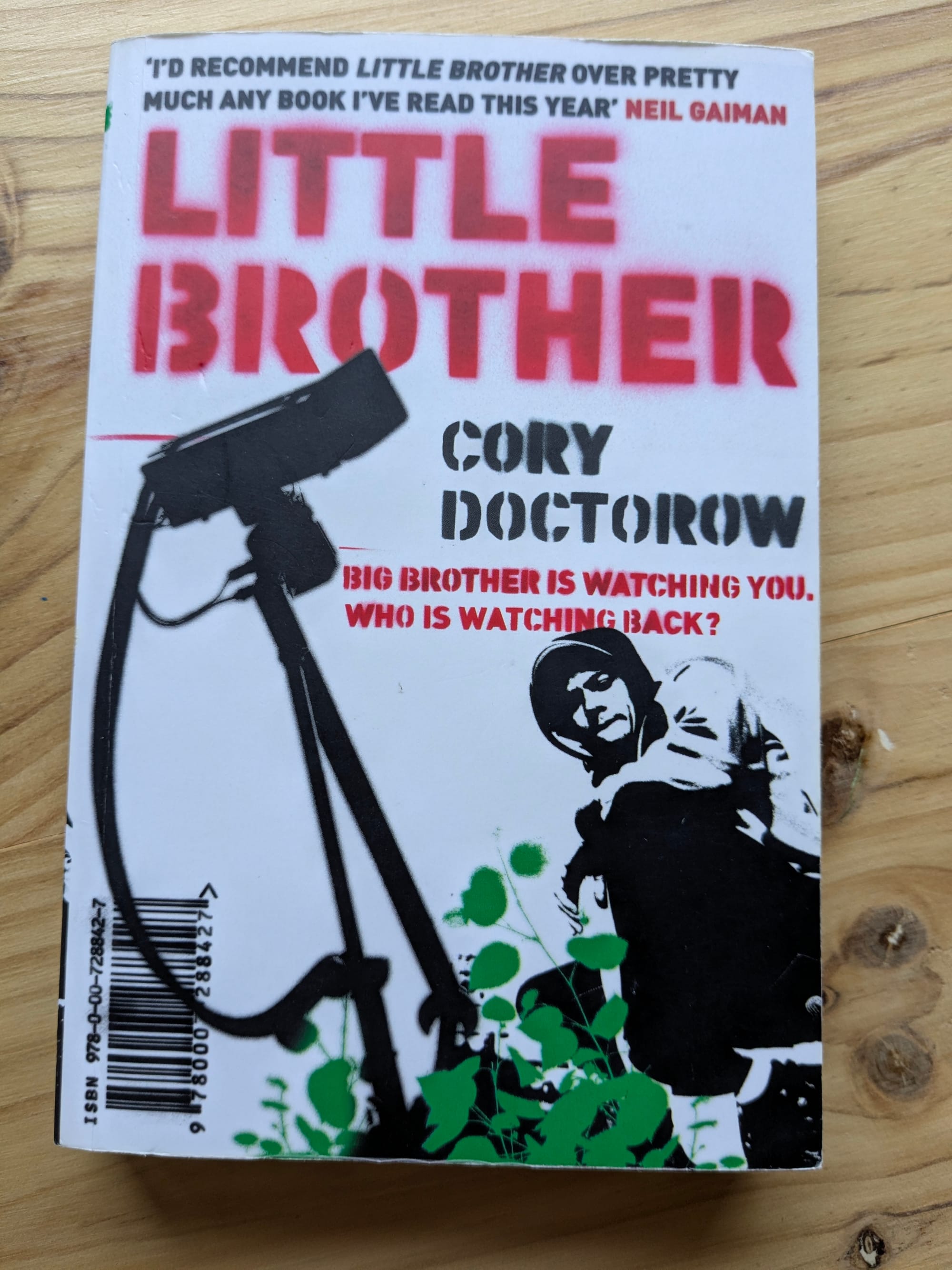
Little Brother, by Cory Doctorow
386 pages, First Published: April 29, 2008
If you're like me, you might know Doctorow mainly from his articles and essays. For some inexplicable reasons I had never ventured to read any of his fiction books. Big mistake!
I recently found a second-hand copy of Little Brother, which I read in June... and loved!
It's a sci-fi book that includes all the key elements that should matter to people in the tech space: technology, surveillance, hacking and individual rights, both physical and digital.
The main character is Marcus, a 17-year-old boy with a passion for computers and technology, facing increasing surveillance at school and in the streets. Following a dramatic terrorist attack in San Francisco, Marcus and his friends find themselves fighting for freedom against an oppressive Department of Homeland Security (DHS). I don't want to spoil the story beyond this, as it's really worth reading.
One interesting parallel, though, caught me as I was reading, and it's worth mentioning. As you might remember, last month I re-read 1984. (Spoiler alert)
 Sergio Visinoni
First there is the almost obvious callout in the nickname of the main character, Marcus Yellow: w1n5t0n, which is 'leet' – or 1337 – for Winston, the name of 1984's main character. Though the nickname will change over the course of the book, I found the reference quite telling. But that's not the only one.
There is a passage in the book in which Marcus is being held captive and tortured at length. That passage reminded me, very vividly, of the same experience of Winston Smith as described by Orwell.
So I was only mildly surprised when I saw 1984 mentioned as one of the explicit references in Little Brother's bibliography.
Like its "big brother" equivalent, Little Brother is an engaging read that is deeply thought-provoking. The fictional events described could be very much translated to today's society, with ICE, Flock and Palantir as the main bad actors. But there is more, a strong message for all of us who love technology: seize the means.
While there's a constant push of moving people up the stack while making the underlying layers increasingly opaque, we should actively push in the opposite direction. We need to be able to understand how things work and make them work for us, individually and collectively. The more we give up our understanding of the inner workings of the technology, the more we abdicate our ability to control our destiny.
In other words, convenience is a comfy trap, one that rarely benefits us in the long run.
84k by Claire North
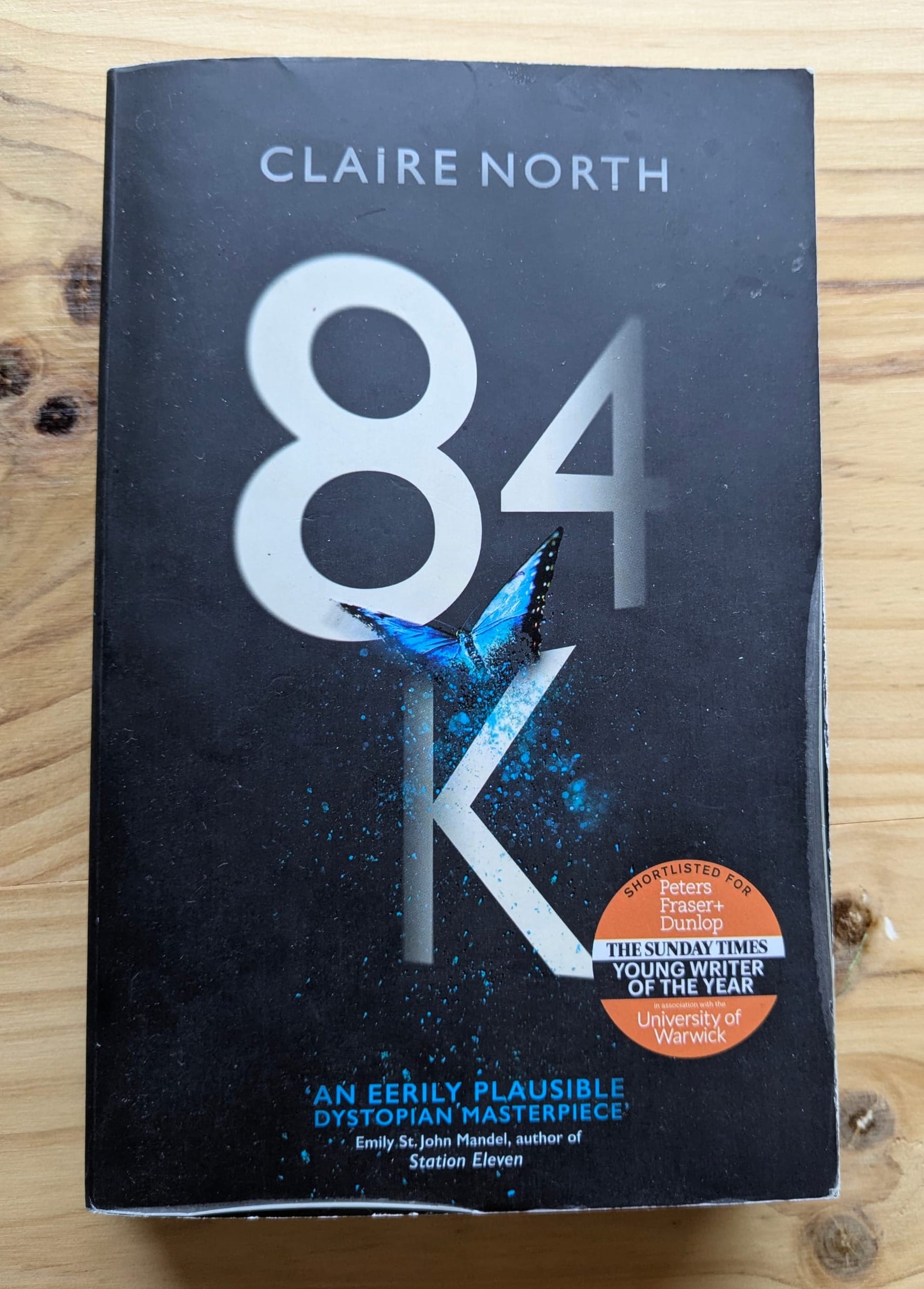
84k, by Claire North
480 pages, First Published: May 22, 2018
I bought this book somewhat compulsively due to three reasons:
- The title, which reminded me, of course, of 1984
- It was blurbed by Cory Doctorow himself
- I found a second-hand copy available on my favourite online bookshop.
What a delightful surprise!
It's definitely the darkest book I've read in a while. Dystopian. Dark. Different.
The author's writing style is quite unique and could put off people used to more traditional writing. It takes some time getting used to incomplete sentences, or major ellipses. For me, after a few dozen pages, it became a pleasant signature for the book itself.
In my research after reading it, I found out the author, who prefers to be referred to with the neutral pronoun 'they', is autistic. With the risk of falling into some silly cliché, I'm assuming part of their unique style could be attributed to that. But I know close to nothing about autism, so I apologise if I just said something completely stupid.
84k has plenty of echoes from other dystopian sci-fi works. Besides the obvious reference to 1984, it also reminded me of The Road and even Stalker (the movie) and Mr Robot (the TV show).
The author's Wikipedia page states that they write science fiction and novels based upon the work of Homer, the ancient Greek poet considered the author of the Iliad and the Odyssey. It's been a long time since I studied those in school, so I couldn't find any specific reference to them in 84k. If someone has any clue, please reach out.
That said, as I'm a big fan of the genre, I'm pretty sure I'll read most of their books, and I'll hopefully be able to find references to Homer in other titles.
La Tentation Artificielle by Clément Camar Mercier
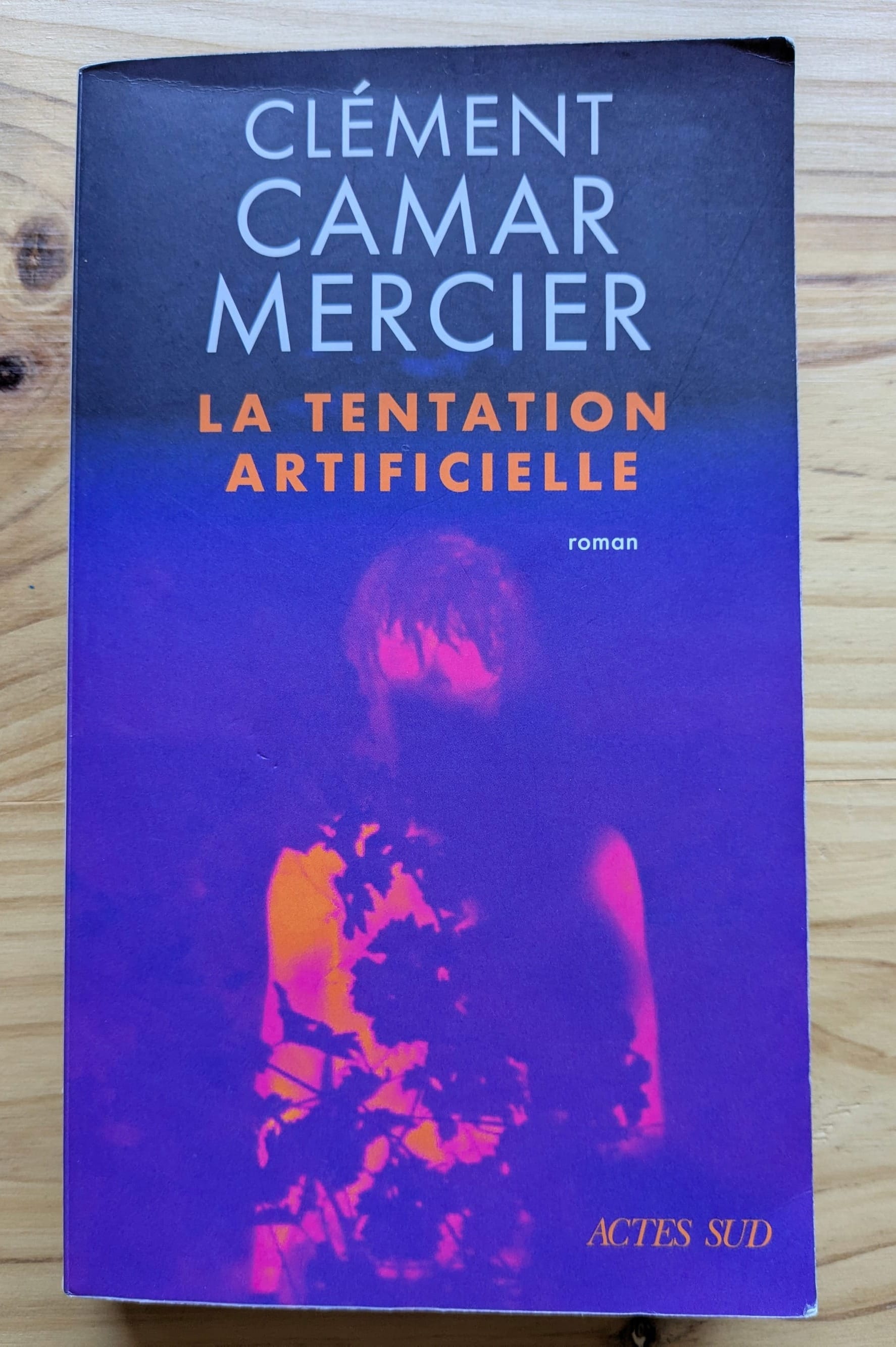
La Tentation Artificielle, by Clément Camar-Mercier
384 pages, First Published: August 20, 2025
The last book of June was also a somewhat dystopian sci-fi novel, this time from a French author. I discovered Clément Camar-Mercier from an article he wrote in a recent issue of Philosophie Magazine on the topic of AI2. La Tentation Artificielle was mentioned in the author's bio, and I could not resist the temptation of getting my hands on a (second-hand) copy.
It's the story of a computer science genius who, after having worked on key recommendation and personalisation algorithms for most major tech companies, sets off to build the most advanced AI solution, named Eliza, a reference to the famous chatbot by professor Weizenbaum.
While the storyline was quite engaging and interesting, especially for someone with a computer science background, at times I found the prose a bit too heavy and unnecessarily complex. But not even in a peculiar and rich way of an Alain Damasio, just enough to be annoying without being a unique marker, a signature, of the author.
While not my favourite book of the month, it's still an interesting and very relevant read. But I'd definitely read 1984, Little Brother, Anathema, 84k or The Mars Trilogy first, just to name a few.
To continue the list of references started with the review of 84K, La Tentation Artificielle had some obvious echoes of Her (the movie) but also of American Psycho. You might be surprised to read that, and I won't reveal the reason.
I'll leave you the pleasure of discovering it by yourself as you read the book.
See Varoufakis's Wikipedia page for more details↩
I know that sounds utterly pretentious and snobbish: a French magazine on philosophy! It's actually quite a good read, accessible to anyone with knowledge of the language. I don't pretend I understand all of it, as many references require more advanced education on the history of philosophy, but they regularly cover topics that are highly relevant in today's society.↩


Comments ()