
How exactly is doing more AI going to make it better?
A reaction to two recent popular articles by Charity Majors. Is AI a big deal? Is resistance to AI fundamentalism? Does the solution to the current problems emerge from doing more of it?

I recently read a couple of very interesting articles by Charity Majors that struck a few chords and left me with a feeling of unease.
Both articles are extremely well written. They sound convincing. The supporting arguments feel solid. Yet, I couldn't help but feel unconvinced. They reminded me of the familiar feeling I have when I read AI-generated text: it sounds correct, but something feels off.
As I reread both articles over and over, I noticed what made them ultimately unconvincing to me. While I do agree with some of the statements here and there, I now understand why I disagree with the key conclusions.
Today's article is an attempt at articulating my views and further contributing to the discussion.
I must admit that I initially wanted to write a follow-up to the first article, as I immediately noticed that the elephant in the room of ethical considerations was completely absent, but Charity beat me to it and wrote a follow-up which was supposed to deal with that aspect specifically.
Assuming that covers the main objection I had, which, as we'll see later, I don't think it did, there are still a couple remarks I believe are worth making on the AI enthusiast vs AI sceptics piece.
Sudo Make Me a CTO is a reader-supported newsletter. If you enjoy the content and would like to see more of it in the future, please consider upgrading to a paid tier. Thanks in advance!
Biased Characterizations
The article seems to be grounded on a neutral view, trying to find the proverbial middle ground. I know for a fact that Charity has mentioned that both "sides" have accused her of being on "the other side". I am not here to take one side or the other. Not my game. What I want to point out, though, is a not-so-subtle dissonance in the text, which opens with a common and perhaps superfluous1:
First, a reminder. We care about the same things. We are on the same side. None of us are assholes.
So far so good; nothing to complain about. But as I move on with the article, I encounter this interesting imaginary exchange between the enthusiast and the sceptic. This is how Charity describes that exchange:
Enthusiast: “Let’s ship without code review! Company X is doing it. This is clearly where the world is headed. Why do you hate the future?”
Skeptic: “Are you fucking kidding me right now? I’ve got people I’ve never heard of submitting diffs in crayon and you want me to just auto-accept this shit? Your father was non-technical and your mother had a face like a donkey, and together I guess they made you.”
Now I am dumbfounded. The sceptic in this vignette speaks like an arsehole, quacks like an arsehole... you know how that one ends. All the traits are there: violent language, personal attacks, and a little dose of sadism. Notice that none of those are present in the politically correct manners of the enthusiast.
I don't know whether this characterisation was done on purpose, subconsciously, or accidentally. And it doesn't matter. What matters is that it clearly projects an image that influences the reader into preferring one approach over the other. Typically, that would be the more professional and respectful tone, unless you're a big fan of the BOFH tradition.
If that was the whole point, then congrats for the choice of words and attitudes described. If it wasn't, then it's an unfortunate accident that undermines the core thesis of the whole piece.
System thinking, where are you?
I might have hallucinated it, but when I first read the article, I was pretty sure one of the illustrations mentioned system thinking. I remember it vividly as I scanned the article a few times after noticing it, only to confirm my initial impression: system thinking was nowhere to be found in the text.
And that's a pity.
Because the so-called utility argument is flawed, or at least not very helpful. What do I mean by that? Well, the utility argument is the one that states that as long as a technology, tool, product or service has some utility, then it's worth being used. This approach tends to take a very narrow view in the assessment of utility, such as whether using AI can speed up software development. So, as long as you can demonstrate that predicament to be true, its usage will be justified.
This is largely the underlying idea of Charity's first article: thanks to examples seen in other companies, there is some utility. I believe we can get there too, and we'll just need to control for the side effects around quality and incidents.
The problem with the utility argument is that it ignores a more fundamental question. Are the benefits offered by this new technology so big that they overcompensate for its drawbacks? In other words, is this new technology worth its overall cost?
Because you know what else, besides AI, has some utility? Asbestos, fossil fuel, social networks, fentanyl, and even Windows Vista, if you squint hard enough.
But back to the considerations around AI.
Here is where systems thinking comes into play, as the next question you need to answer is the following: which system are you considering to assess the cost/benefits of the new technology? If that's just your company, it might be easy(er) to make the ROI calculation work in your favour, but you're hiding the lion's share of the technological costs under the proverbial rug technically called externalities.
Interestingly, one of the illustrations contains the cryptic sentence "The externalities have entered the chat", but it isn't at all clear what it refers to, as the article fails to clearly state which system is being observed.
So, when I heard that Charity was writing a follow-up article to address the ethical angle, I was genuinely curious to read it, and I expressed my key concerns in this post on BlueSky.
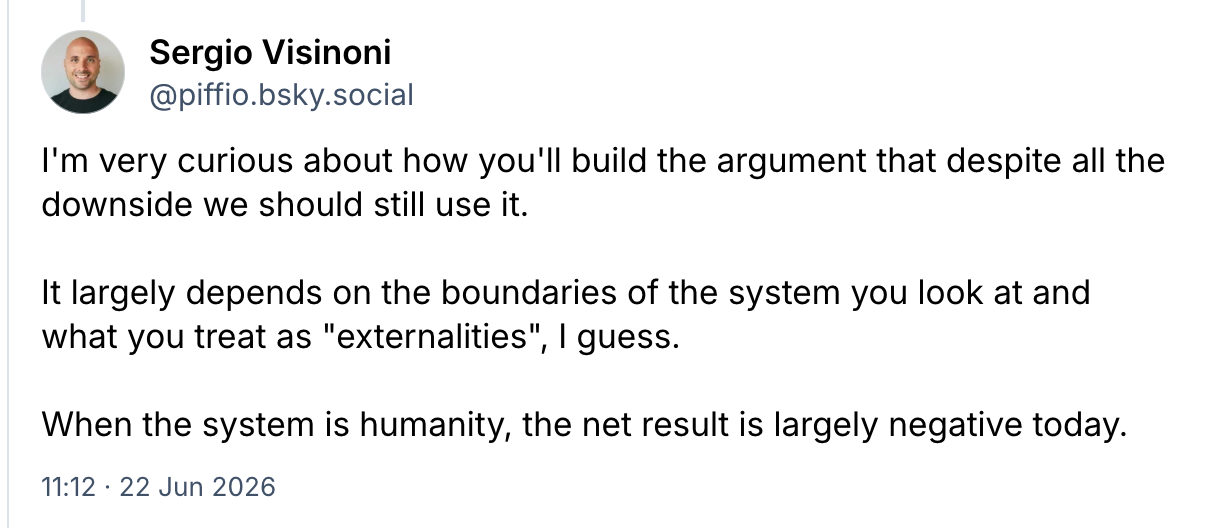
When the follow-up article came out, it caused a similar feeling as the first one: while I did appreciate the eloquence and some statements, I was not convinced by the set of arguments put forward.
I'll now try to explain why.
Charity's key points
First of all, after rereading it multiple times, I believe the key points it's making are the following:
- AI is nothing special. It is "just technology". Let's make it boring.
- People who refuse to use AI are essentially fundamentalist.
- The best way to make AI less harmful is to use it more because we're the good guys.
Before you ask: no, I didn't ask a chatbot, LLM, or other automated tool to come up with those points. If you do, you'll probably get different results. These are my key takeaways after reading it and are the key points I want to focus on next.
AI is not a big deal... or is it?
The central point of the article is that we should all chill out, because AI is not a big deal. Seriously, it's just plain, old, boring technology. Is it though?
It bothers me when I see people holding AI up like it’s something special — uniquely evil, incomparably harmful, irreparably tainted. It is none of those things. AI is just technology.
While I'll defer the problem of defining what AI is in this context to a later section, I want first to highlight how both articles in fact seem to undermine this whole idea.
In the first one, trying to have enthusiasts and sceptics shake hands and move on with AI adoption – because that's what it's all about, finding ways to justify the adoption while smoothing the rough edges – Charity calls this "the leadership challenge of the present moment" and says the following:
Being late to AI and grinding your team down into a pulp are two especially grim risks we must steer between.
And also
The enthusiasts are not wrong. We are starting to see real, non-imaginary, discontinuous leaps in capabilities from teams that lean in hard to working with AI. And this does not feel like a normal technology cycle where you can wait for the dust to settle; teams that sit this out while competitors are hustling could be out of business before the dust settles. That’s a real, existential threat.
That kind of sounds like it's a big deal, doesn't it?
And in the follow-up article you could read
Whether we like it or not, AI is here to stay. If the future of tech is being written right now — and I believe it is — what’s the plan?
So, what are we trying to say here?
Is AI a real, existential threat? Is the future of tech being written right now? And therefore, should people have clear, possibly strong, views on how they'd like this to pan out?
Or are we talking about something that is just technology? And therefore, we should all just chill out?
And ultimately, is Charity's article contributing to chilling out, or is it perniciously contributing to the FOMO and corresponding feeling of distress this is causing to vast slabs of the population?
It really doesn't help that I recently re-read 1984 and, therefore, have been wondering if this isn't an example of double-speak. But as I have no reasons to assume bad intentions from Charity, I simply believe this is a sign that dealing with this topic is hard as shit (technical term). That it's difficult to wrap our heads around it.
And the fuzzy definitions only make things worse.
What is AI?
I don't want to go down a rabbit hole of semantics and history, but a big portion of the confusion we're seeing today when people talk about AI is that the term lacks any clear definition. The term has been around for more than half a century. As The AI Con2 explains, since its inception it lacked any clear definition and was largely used as a marketing term to obtain public funding.
 Sergio Visinoni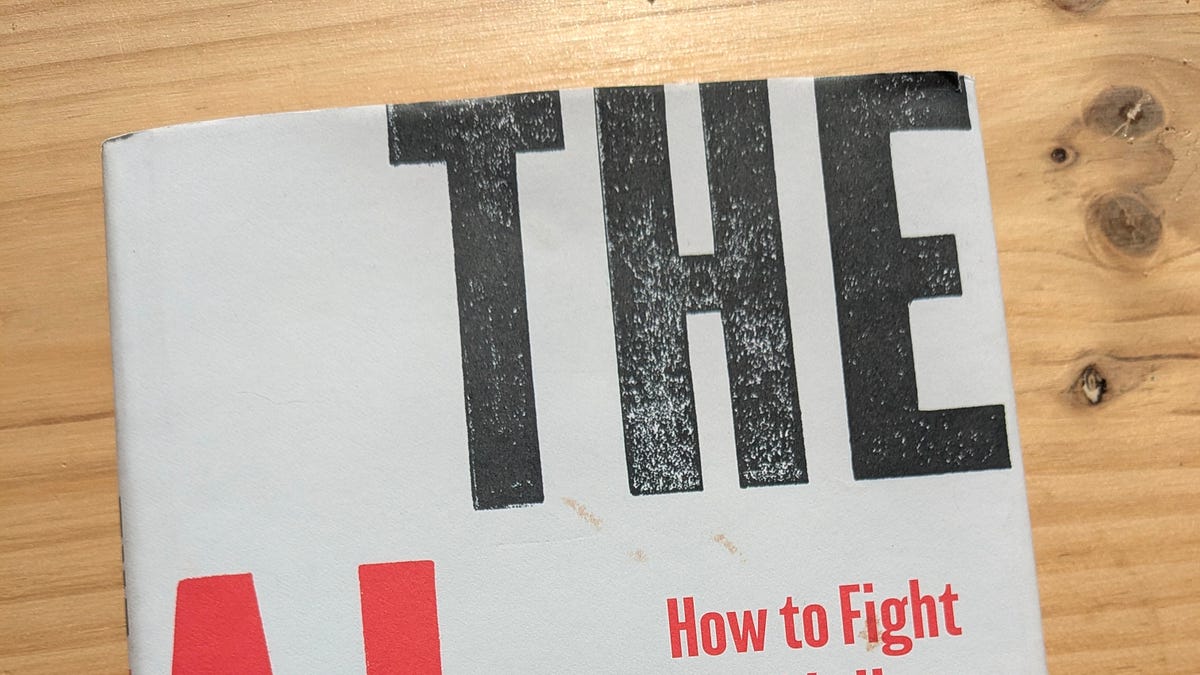
Things have only gotten worse in recent years, as new ludicrous acronyms have emerged, such as 'AGI' or 'ASI', further contributing to the confusion and sense of an impending Terminator-like future.
While I won't even try to offer a definition for AI, I'd like to focus on a slightly different and hopefully more helpful question.
What do people refer to when they say AI these days (July 2026)?
In my understanding, 'AI' is invariably used to refer to LLM-based products: chatbots, coding assistants and agents, and various forms of pseudo-autonomous copilots able to perform tasks on your behalf.
Unless explicitly stated otherwise, in the remainder of the article I'll be referring to this arguably narrow, hopefully useful, definition whenever the term 'AI' is used.
If we accept that this is what people refer to with the AI term most often, I want to revisit Charity's statement that AI is just technology3.
Without further nuances, that statement is as useful as saying "Coal is just a mineral!" or "Cocaine is just a plant!"
Technology is another complicated word. It's used, misused and abused ad nauseam, and while we all have a certain intuition for what it is, its real definition is also vague. For instance, one definition offered by the Merriam-Webster dictionary is the following:
a machine, piece of equipment, method, etc. that is created by the practical application of scientific knowledge
But beyond its vague definition, the term 'technologies' carries a lot of assumptions for many people. Some of them are very far from obvious.
Technology is neutral, is it?
I don't have numbers at hand, but anecdotally I can say that a significant amount of the population believes in the axiom that "technology is neutral". That's particularly true among tech workers, to the point that this is often presented as a truism.
The reality is that the debate on whether technology can be considered neutral or not is still unsolved, with both perspectives relying on their own set of arguments. We're not going into a philosophical exploration here. I'm far from equipped for it, and I probably never will.
So, instead of engaging in hair-splitting arguments, I'd like to offer an alternative, pragmatic perspective. One that tries to differentiate technologies from products.
In this distinction, technologies are a combination of acquired knowledge and practices that can be applied and recombined almost infinitely. In the context of AI, transformers, autoregression, backpropagation and reinforcement learning can all be considered technologies. If we adopt this definition, it becomes easier to uphold the beliefs that technologies are indeed neutral.
What about products? These are generally the application of different forms of technologies, labour, beliefs and capital that are built for a specific purpose. In the context of AI, specific models such as GPT-5.5 or Claude Sonnet 4.8 are products, as well as the chatbots using them or code harnesses such as Claude Code or OpenCode or Codex.
Products are not neutral, and that stems from the simple fact that they've been built with a specific purpose, with biases and values codified in the form of the various tradeoffs they embody.
While the boundary between the two groups is somewhat blurry (are LLMs technology or products? It depends.) I find it helpful in the sense that it helps us better understand the way in which people reason and engage with them.
In particular, it should help us dispel the centuries-old misunderstanding that rejecting the emanation of technology through specific products is to be considered anti-technology, regressive or, as Charity seems to put it, fundamentalist.
Dismissing resistance as fundamentalism
The most widely accepted definition of a Luddite is "someone that is against any forms of technology for ideological reasons", or a variation of that.
To use more precise words, most people use it with the meaning reported in point 2 by the Webster's New World College Dictionary.
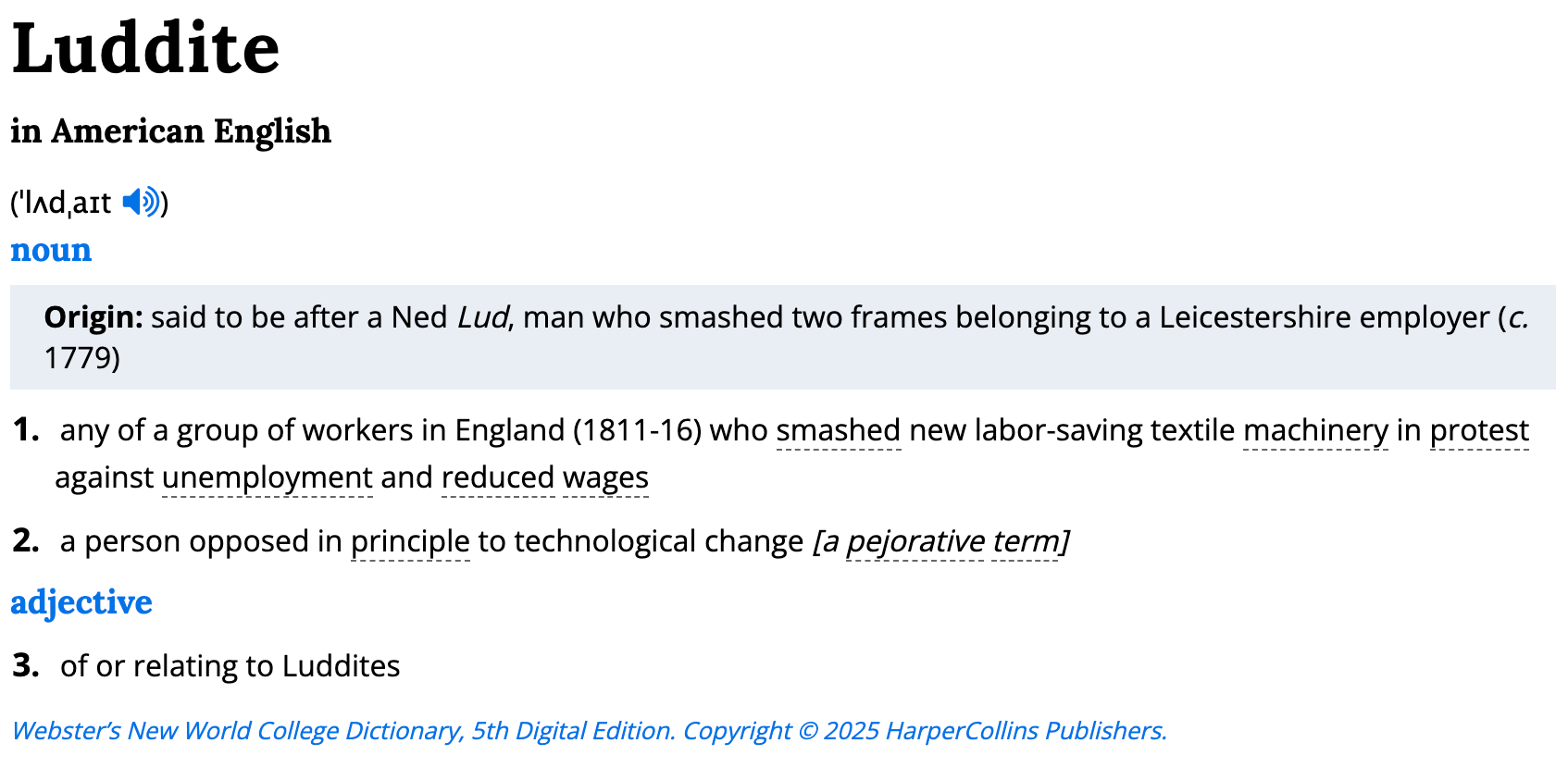
As Brian Merchant explains in detail in his excellent book Blood In The Machine, that definition is not only misleading, it actively serves – and served – the purpose of raising capitalists imposing misery upon a whole class of craftsmen for the sake of increased capital returns.
 Sergio Visinoni
While I do agree with Charity that purity is not and should not be a goal, I disagree with the Manichean narrative that seems to characterise anyone refusing to engage with specific products as fundamentalist.
I agree with the fact that pointing fingers at each other only makes us worse humans while playing the game of the powers that be. But what is labelling the unwillingness to engage with specific products as fundamentalism, if not another form of finger-pointing?
If we take the reasoning to an extreme, are we saying that one should feel sorry and ashamed if they decide they're not willing to use AI and openly talk about it? That the burden of proof and explanation should be with those who don't want to use it? And why, exactly?
Change can be triggered by a broad set of actions and decisions.
Rosa Park didn't change the world by setting up a new bus company. She simply refused to abide by a discriminatory law. The Luddites didn't destroy all technology; they specifically targeted the power looms and other machines that were actively used against them. Gandhi decided not to engage in violent actions, and that's what made his movement strong.
Most, if not all, AI products today live on the premise that models will continue improving at roughly the same speed as today (unproven); that demand will continue to grow (also unproven); and that out of all this they'll figure out how to make unit economics work (do I need to say 'unproven' or is it clear by now?).
In other words, society seems to have been forced into an experiment of unprecedented scale that is based on the assumption that positive advancements for humanity are an emerging property of a system created by handing morally questionable people an obscene amount of money, solely on the merit that they have convinced investors they know what they're doing, while they clearly don't.
One way we can influence that, as citizens and potential users, is to decide not to use those products. It's not the only lever, probably not the best one. But one nevertheless.
But maybe I just got it wrong. Maybe, despite calling out withdrawing as a lousy strategy, Charity didn't mean it to be fundamentalism. Maybe 'fundamentalism' was only used to indicate people who look down at others for being impure?
If that's the case, I'll just admit I didn't get it right and move on to the next point.
For that, I'll go back to the article's title: Is it ethical to use AI?
Is it ethical to use AI?
Though I understand that Charity might have experienced people pointing their fingers at her for using AI, I think the question is the wrong one to ask. In fact, it only takes a few seconds to rule it out as 'no, it's not unethical to use AI'.
It's not unethical to use AI, as it's not unethical to indulge in other so-called "impure" activities. Like using recreational drugs, driving an internal combustion engine car, or gambling4. It's not unethical, as, in most cases, people don't have a choice but to engage in such activity. Either out of economic necessities, traumas or compulsive needs, they struggle to control.
I think blaming someone who uses AI is as helpful as blaming a drug addict or someone who drives a 12-year-old diesel car to work. The self-righteous stance might make you feel good, but it won't do a lot to solve the problem of addiction or climate change.
There is a more interesting and helpful question to ask ourselves, though.
Is it ethical to promote and incentivise the use of AI?
As I've written about it previously, I do have a problem with that.
 Sergio Visinoni
In particular, if we go back to the definition we shared earlier, I do believe that promoting the use of the currently available AI products is unethical5. Period. I cannot find ways to put it more mildly, as I'd be lying. That doesn't mean I judge people following that path. I just hope they all have reasons beyond greed, opportunism or "I was just following orders" to do it.
Reasons that I can't personally fathom, and the arguments I've read so far are unconvincing.
How exactly using it more makes it better?
There's a passage in the article that I found hard to swallow, and it goes as follows.
Whether we like it or not, AI is here to stay. If the future of tech is being written right now — and I believe it is — what’s the plan? Walk off the field and abandon it to whoever has fewest scruples? Come on.
Let's just pause there for a second.
There has never been a worse time in history for being a tech worker. And I'm not making this one up. As Cory Doctorows describes it very clearly in Enshittification, tech workers have recently discovered what almost all other professions have known for decades, if not centuries: they're replaceable, and they have very little leverage left. This is why in recent years we've seen something that we would have considered science fiction a few years ago: tech workers are starting to unionise.
 Sergio Visinoni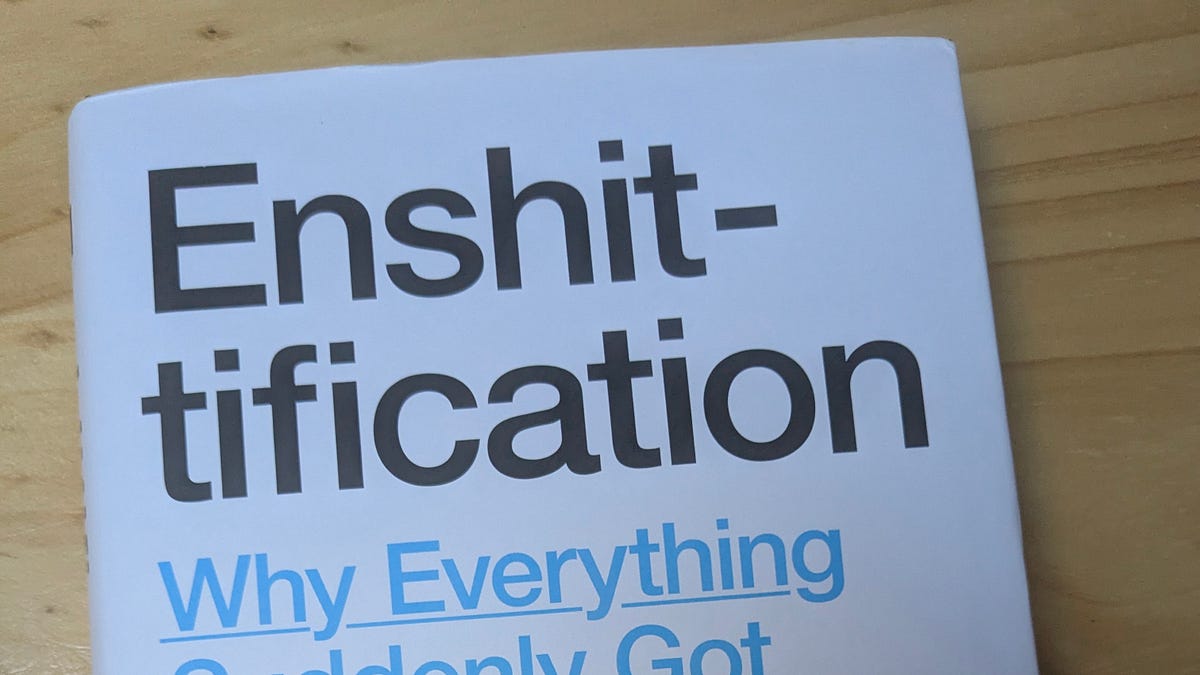
It's not only that. Many people I know of, and also people I don't, are literally walking away from the industry or are seriously considering doing so. It's something I have been considering myself for the past few years, and the move from employee to independent consultant is definitely geared in that direction.
The fact that the tech industry is basically controlled by a handful of billionaires (and one obnoxious trillionaire), with ties into the most authoritarian, erratic and overtly fascist administration that the West has ever experienced since WWII, has a lot to do with that. Funding for independent research is being cut everywhere. Companies such as Flock and Palantir are deploying technology products with the declared intent of surveilling citizens and allowing those in power to harass, persecute or deport anyone they don't like. All the while, the CEOs of the most prominent AI companies are participating in the G7 meeting as if they had any mandate to represent whatsoever besides greed and insane valuation.
If Mary Shelley were alive today, she'd probably write a book titled "Frank-Epstein". Except this one won't be science fiction but investigative journalism.
In such a scenario, with a level of distress among the population that has reached peak-pandemic levels6, I find it hard to rally behind this naïve call to arms.
To my mind, the goal is not to make AI disappear. It’s too darn useful, and anyway, we can’t. The goal is to make its use disciplined, social and accountable. Let’s do the work it takes to live with powerful tools and govern them responsibly.
I simply do not believe this path, the path of the insider tech worker relentlessly pushing for things to get better from the inside, will ever lead to any meaningful results.
Scott Hanselman has a great TED talk about technology's failure to deliver. And technology, and us all tech workers, failed to deliver during the two and a half decades in which tech workers had a lot of leverage.
Despite that, we didn't prevent Google from becoming a shitty product for users, publishers and advertisers. We didn't prevent Facebook from willingly ignoring mental health issues caused by social network use among teenagers. We didn't prevent Amazon from becoming the workplace where the rate of warehouse incidents is twice as much as the industry average. And we surely didn't prevent Uber from becoming a horrible wage-depressing machine with zero liability.
I think we failed on all those fronts for a simple reason: we were too busy engaging with fancy and arguably advanced technology to care too much about how it was put to use.
So, while I agree with the idea that we need to find ways to push back, I simply don't see how playing more with AI, using more of it, and building more of it will make the problem better.
Because this is not a technological problem, it's a political one.
You don't solve climate change by building slightly less polluting internal combustion engines.
You don't solve gambling addiction by building slot machines that let the user win just a little bit more.
You don't create less disgusting iPhones by installing anti-suicide nets at Foxconn.
You don't solve lung cancer by farming fucking organic tobacco.
You need something more radical. You should not look at incremental improvements for something fundamentally broken.
You need to look for truly radical actions.
And when products are based on the premise of users' engagement as the main driver for success, power and control, refusing to engage with them could turn out to be a lot more radical than simply trying to mitigate their worst side effects.
Hope is not a strategy
Charity has a strong background in SRE, so I'm sure she's familiar with one of my favourite mottos ever, from the days when Google still pretended to be a respectable company. "Hope is not a strategy" has been for years the motto of Google's SRE team.
When I look at the AI industry today, what I see is:
- $1.5 trillion invested in the past 4-5 years. This is an obscene amount of money. For comparison, in 2025 the US spent about $400 billion in green energy. The opportunity cost of all the money going to AI buildup in this particular historical moment is probably the most irresponsible action humanity has ever undertaken.
- The US is investing more in fossil fuel than they've ever been, well on track to overtake China this year. This is mainly driven by data centre build-up.
- That is happening when Europe is experiencing the most violent heatwave in history, and the Mediterranean Sea is starting to boil.
- CEOs of the most prominent AI companies causing distress and unrest with their repeated irresponsible doom-trolling and ridiculous claims.
- All the while they're trying to rush to IPO, as they want to shift the risk of their questionable valuations into the hands of the public market and pension funds and cash out before it's too late. In other words, they are forcing us to become their exit liquidity.
- The looming financial crises, which will impact the average person more than anyone who's been actively responsible for causing it.
- The stock market and investors overall are salivating at the idea of being able to get rid of or significantly reduce what they have taken to refer to as the salary tax.
- Some of the most important commons of our industry, namely key open-source projects such as curl or the Linux kernel, are being flooded by an insane amount of slop, having to waste their precious and limited time on finding ways to mitigate the negative effects.
And we should get along with all this because why exactly? Because it makes us write more software, faster? That doesn't sound like a strong enough argument.
Why do we need more software, exactly? Play the 5-whys trick on this assumption, and let me know if you're not staring into the void after the 3rd why.
Or are we factoring in speculations about potential and unsubstantiated future benefits? Belief is the realm of religion or magical thinking. I don't attribute any probationary evidence to each of them.
I don't question that there is some utility in AI, but back to the question of the system's thinking, as I posted it to BlueSky: is it worth all the costs we, as a society, as a civilisation, are carrying for it?
And more importantly, have we stopped and asked ourselves the fundamental question about what a world without all this would look like?
Do we need AI? I really mean it7. As a species, in the 2020s, what place should AI development have in our list of collective priorities? I personally struggle to make it to the top 10 list. In fact, I'm deeply convinced that everyone's life (with the exception of a handful of despicable millionaires and grifters) will be significantly better without it.
Because it's little more than a sophisticated distraction that we're all buying, like we've been buying our iPhones and our Amazon Prime subscriptions. Because someone has succeeded in fabricating needs we didn't have, and now we seem to be unable to do without them.
Refusing to engage with it might prevent it from becoming ubiquitous, as a few people would love it to be the case. It might not be here to stay if it doesn't gain further traction. And if you tell other people to do the same, this goes from being a desperate individual action to becoming a potentially powerful collective action.
Paradoxically, the best way to make AI work for us (with 'us' intended as the whole population, not a technocratic minority) might be to simply stop doing it and redirect those investments towards more pressing and concrete existential threats.
Though the chances are low, this sounds to me a lot more effective than believing we can make AI slightly less harmful by working on it from the inside.
Simply because the precedents aren't there. The plan isn't there. And in times when evil powers are ruling, moderate, centrist, balanced positions end up being enablers.
I think it's time we stop pretending we're saving the world by indulging ourselves with remarkably interesting and useful technology. That's a convenient take, but a provenly ineffective one. Because as long as you're playing along, you're playing with the system.
Or, as Timothy Snyder has said in the straightest possible way.
Don't obey in advance
And in the current socio-techno-political environment, what is the most obvious form of obedience, if not... right. You guessed it.
Many authors fall into the trap of having to put disclaimers, as they're afraid of being misinterpreted. I used to do that a lot. But then I learnt from better authors that it's unnecessary: attentive readers will understand your point by the way you frame it, not by the disclaimers to rule out all possible misinterpretation. An impossible task by definition.↩
The book includes a detailed history of the origins of AI and the early players in that space. As the authors say, referring to 1956, when the term was apparently coined by John McCarthy, just as it is today, the term "artificial intelligence" did not have much coherence.↩
Plenty of people make use of that statement, but here I'm referring to the fact that it's being used, in bold, in her latest article.↩
It's not by accident that I've chosen these three categories for the analogy, as GenAI (ab)use has something in common with each one of them: it shows strong indicators of addictions, it has an awful effect on the planet, and seems to trigger reactions very similar to the ones found in gambling.↩
Remember the distinction between technology and product from a few hundred words ago.↩
Cal Newport recently published a great op-ed telling AI companies they should stop engaging in what he calls Doom Trolling, as this is causing pandemic-level widespread distress across society. And he's right.↩
To help people find the answer, I built a website a few months back.↩

Comments ()